What next for property market?


|
 |
|
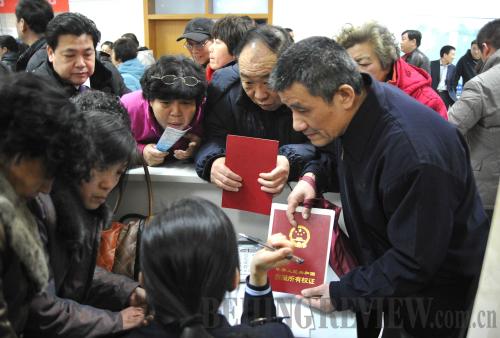
Residents in Jinan, Shandong province, consult agents regarding property transactions in the provincial capital on March 4.[Photo/Xinhua] |
Bo Wenxi, vice president of Zhuoda Group, a domestic property developer, said there are three reasons for the ongoing surge in housing prices. "First, local governments strongly rely on land sales and the real estate market as significant parts of their fiscal revenue and GDP growth. Second, demand will outstrip supply for a long time in China. As more rural people flock to cities, the demand is getting stronger. With further urbanization underway, this trend will be intensified," said Bo.
"Finally, housing prices are affected by currency issuance. Under the influence of quantitative easing in many Western countries, China has to implement quantitative easing policies as well, for fear of large-scale capital flight. With so much money in the market, it's quite unlikely that property prices will fall."
He said, "Two months after the new tightening policies, the market has rebounded. Prices are continuously rising after a short period of hesitation and observation from buyers."
A way out
For the Central Government, housing price controls have become vital in improving people's livelihoods amid growing public complaints over runaway real estate prices. While purchase limits proved to be ineffective, a property tax was touted as a much-needed solution to skyrocketing prices. In China's real estate market, a property tax—while well-established and taken for granted in Western countries—is a relatively new phenomenon in China, and is viewed as a measure to restrict the buying of homes for investment purposes.
Recent rises in China's housing prices have fueled calls for an expansion of the tax, which has been limited to only Shanghai and Chongqing. Property taxes in the two cities were introduced on a trial basis on January 28, 2011, in a bid to help cool the real estate market. Nearly 20,000 units of residential homes were hit with a property tax in Shanghai in 2011 and the number jumped to 37,000 in 2012, bringing in 2.46 billion yuan ($395.1 million) in tax revenues last year, according to the city's finance and taxation authorities. The Shanghai property tax model covers only buyers of second homes, while the Chongqing program levies it on both new and existing high-end houses.
"In China, most taxes were levied on property transactions instead of on property ownership. This is really unreasonable," said Li of the CASS. Li suggested the government expand trial property tax programs to more regions to avert a possible price rebound in 2013.
Jia Kang, Director of the Research Institute of Fiscal Science, affiliated with the Ministry of Finance, said the property tax would expand to more cities this year. The CASS blue book also mentioned that maintaining a steady land supply and accelerating the construction of affordable housing projects are effective ways to tame the overheated market.
"Local governments should guarantee fairness in the allocation of affordable housing, by setting up a transparent system. Also, the system should cover migrant workers in cities or townships," said Li.
"Land supply should be scientifically planned according to regional conditions. In first-tier cities and cities with faster-than-expected surging housing prices, more land should be put into use for the construction of residential housing. In third- or fourth-tier cities with too much inventory, land supply should be reduced to avoid rampant construction."