Li promises to speed up service growth


Premier Li Keqiang criticized the slower development of service industries compared with the rest of the economy, pledging on Tuesday to speed up growth in the sector to create more urban jobs.
One focus of the central government is to let service industries play a bigger role in boosting growth and creating new jobs, Li said in his keynote speech at the China International Fair for Trade in Services in Beijing.
 |
|
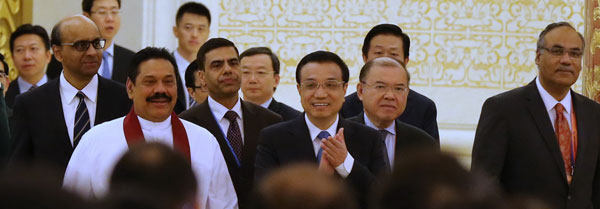
Premier Li Keqiang (center), Sri Lankan President Mahinda Rajapaksa (front row, first left) and other senior leaders visit the China International Fair for Trade in Services in Beijing on Wednesday. XU JINGXING / CHINA DAILY |
China is facing a severe job market challenge this year when it will have to provide work for about 7 million new college graduates.
Li said the nation will have to forge ahead with economic reform, including further opening up to overseas investment and building free trade zones in pilot cities.
"China will encourage developed service enterprises to go abroad to tap the international market, while welcoming foreign companies to set up headquarters, logistics centers, procurement centers and data centers in China," Li said.
There is a sufficient supply of many manufactured goods — even overcapacity in some industries — but supply still cannot meet demand for many services, the premier said, adding that tapping the potential of the service industries is an important way to improve the efficiency of China’s economy.
Led by information and network technologies and logistics management, service industries tend to bring about many innovations and provide new impetus to overall economic growth, the premier said.
China will attempt to expand its share of the global market in outsourcing services.
Since the start of the country’s reform and opening- up, service industries have made substantial progress, contributing a larger share to the economy than industry, and more jobs than the agricultural sector.
Nonetheless, Li said the service sector remains a weak point of the economy, comprising 44.6 percent of China’s GDP in 2012, and accounting for 36 percent of the nation’s jobs.
With these figures, China falls significantly behind developed economies, and trails similar developing economies by about 10 percentage points, Li said.
Veteran foreign trade official Wei Jianguo, vice-chairman of the China Center of International Economic Exchanges, a government think tank, said China is the world’s No 1 merchandise exporter, but ranks only fifth in the world in service exports.
Services comprise only 10 percent of the nation’s total foreign trade.
The value-added growth of China’s service sector in the first quarter of this year was 8.3 percent compared with a year earlier, totaling 5.69 trillion yuan ($0.9 trillion) and accounting for 47.8 percent of GDP in the same period, according to the National Development and Reform Commission, the nation’s top economic planning body.
Also at the fair on Wednesday, the United Nations Conference on Trade and Development secretary-general Supachai Panitchpakdi said the organization has set up the Services Vision Council.
The council is composed of senior representatives from the private and public sectors and will provide guidance on the preparation of future Global Services Forum sessions as well as offering an informal and flexible framework for government leaders, business executives and academics to discuss topical issues relating to services.
Panitchpakdi said the service sector not only creates many jobs but will also contribute to global progress in such basic services as water, health, energy and education.
"Though services are mature in developed countries they are confronted with challenges in developing economies ... and cooperation and communications between developed and developing countries are the key to success," Panitchpakdi said.
Hai Wen, vice-president of Peking University, said that under China’s urbanization and development in the next decade the service sector will inevitably grow to contribute the larger share of the economy.
In the first quarter, China’s overall trade in services rose 14.4 percent from a year ago to $120.1 billion, with exports gaining 7 percent year-on-year to $46.5 billion and imports rising 19.7 percent to $73.6 billion, yielding a trade deficit of $27.1 billion, according to the Ministry of Commerce.