Sights set on universal healthcare dream


|
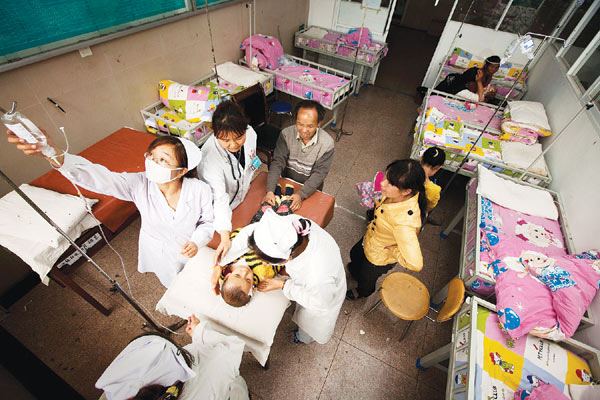 A doctor takes care of a young patient in rural China. China has a goal of providing universal healthcare coverage by 2020. [Photo / Provided to China Daily]
|
Big drugmakers take the road less traveled for bigger gains in China
China's dream of universal healthcare by 2020 is expected to create huge opportunities for foreign healthcare companies in rural China.
Although foreign healthcare companies are already providing training to rural doctors in China through their corporate social responsibility projects, many of them expect the informal collaboration to develop into actual revenue-sharing agreements in the future.
One such example is Denmark-headquartered pharmaceutical company Novo Nordisk AS, which entered the Chinese market in 1994, with a focus on diabetes treatment.
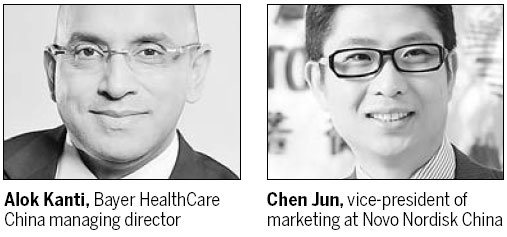
To expand its footprint in rural China, the company has invested heavily in training rural doctors on diabetes treatment because rural areas do not currently receive much healthcare investment from the Chinese government, says Chen Jun, vice-president of marketing at Novo Nordisk China.
"In the past, many rural counties with a population of several hundred thousands did not have well-equipped hospitals or specialized doctors who had the capability to properly treat diabetes," Chen says.
"This means patients frequently had to travel a long way to cities to receive proper treatment, which was unsustainable for the management of the chronic disease because of the inconvenient distances and unaffordable costs because of the relatively low-income levels in rural areas."
To change this situation, Novo Nordisk's China team invested heavily in educating rural doctors on diabetes treatment so that patients receive treatment locally. Chen says this process also helps Novo Nordisk to promote its products in rural markets.
"We have a company culture where commercial activities are linked with corporate social responsibility, so our activities in rural China combine both goals," Chen says.
He says tackling diseases such as diabetes is just as important in rural areas as urban areas because urbanization has meant many rural residents traditionally involved in agricultural jobs are now moving to service-based jobs in nearby cities.
He says that although Novo Nordisk's activities in rural China may take some time to generate financial returns, it is a good sign for the future. The Swedish company believes that following this method will help it make considerable inroads into the overall Chinese market.
Chen's confidence in the ability of Chinese rural counties and towns to increase healthcare expenditure is understandable, considering that China has a goal of providing universal healthcare coverage by 2020.
Currently healthcare coverage is available to 95 percent of Chinese citizens, but many rural residents are still not covered, hence heavy investment in rural China is expected if universal coverage is to be achieved.
In 2012, China's then Ministry of Health announced a new plan to increase the subsidy for each rural resident in areas with income levels under the national poverty line to 360 yuan ($57) from 200 yuan a month.
Rural residents living under the national poverty line will have 75 percent of their in-patient expenses reimbursed by 2015, according to the guidelines.
The ministry has also promised to implement more poverty-relief projects in remote mountainous regions as well as parts of Tibet and Xinjiang, among other poor areas.
"It is important for the Chinese government to ensure affordable and good quality healthcare in rural areas," says Zhang Binyun, deputy director of Fudan University's hospital management research institute.
"To improve rural healthcare, the government should invest more, improve rural healthcare practitioners' capabilities and find a sustainable operation model for rural healthcare," Zhang says.
"All these elements should be implemented together. Investment in infrastructure should be accompanied by enhancement of skills and capabilities of doctors and nurses."