A boost to financial reform


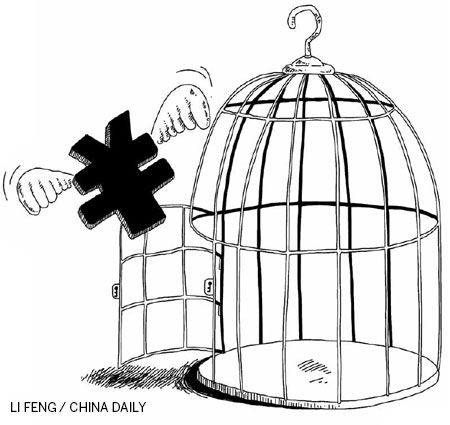
The People's Bank of China announced Friday evening that it will remove the floor for lending rates. This is an important step in the financial and monetary reform process, even though the immediate impact on lending volumes should be modest.
China has traditionally controlled the lending and deposit interest rates that banks can charge and offer, with benchmark rates set by the PBOC. The government has for more than 20 years had a long-term objective of increasing the role of the market in the financial sector and monetary policy. For most of this time progress was modest, but the pace of financial and monetary reform has picked up recently.
In recent years, the authorities have taken steps to give banks more leeway in setting interest rates. On the lending side, the floor for interest rates that banks can charge was lowered to 70 percent of the benchmark lending rate in 2012. According to Friday's announcement, the floor was fully removed, including for the bill discounting rate. The floor on mortgage rates was left unchanged as well as the crucial cap on deposit rates.
The immediate economic impact of the removal is likely to be modest. While the change should have some impact on lending rates, the immediate impact should be small. In the first quarter of this year, only 11 percent of bank loans was extended at lending rates lower than the benchmark, because banks generally had not used the leeway already provided.
This step is also unlikely to have a major immediate impact on lending volumes. Quantitative levers have typically been the binding policy constraints on lending and they have not changed. Also, at the moment corporate borrowing is affected a lot by subdued demand for financing in a context of weak profits and spare capacity in many sectors rather than by the lending rate.
The removal is most of all an important step in the liberalization of interest rates, underscoring the willingness and mandate that the government now has to advance financial and monetary reform. Such reform should increase the role of the interest rate in allocating capital and introduce more competition in the financial system.
Further crucial steps remain outstanding. First, deposit rates continue to be capped. The rationale for this cap has always been that, without it banks could recklessly bid up the deposit rate to attract deposits, putting themselves and other banks at risk.
However, China's banks have a lot of time now to make progress with a more commercial orientation and better risk management and, in the financial sector as much as elsewhere, more competition leads to a better outcome for customers and better efficiency. Offering better deposit rates for savings is key for rebalancing the pattern of growth and leveling the playing field between core banking and shadow banking.
Second, monetary policy will for now continue to rely heavily on quantitative levers rather than interest rates. Notwithstanding the recent interest rate liberalization, the growth of monetary aggregates is still effectively controlled by quantitative instruments such as credit quota and loan to deposit ratios rather than interest rates. This creates distortions, with the price of capital often not reflecting its scarcity. Eventually, interest rates should become the key channel transmitting monetary policy.
Domestic interest rate reform along the lines of Friday's move is also important in the context of exchange rate and capital account reform.
The government has in recent months indicated it wants to step up reforms toward a more flexible exchange rate and a more open capital account, and has also taken some actual steps on opening up the capital account. Economic logic calls for first taking the remaining domestic financial reforms such as those on interest rates before fully freeing up the currency and fully opening up the capital account. Thus, this step helps set the stage for further exchange rate and capital account reform.
Over time, market- and interest-rate-oriented reform should improve the level playing field between core banking and "shadow banking". The rapid growth of shadow banking in recent years has in part been fuelled by low deposit rates and banks' desire to evade costs on core banking stemming from controls such as the loan to deposit and high reserve requirement ratios. Thus, liberalizing interest rates and increasing their role in the financial system should help bring some types of financial activity back to core banking.
The removal of the lending interest rate floor is an important step in financial and monetary reform. The next steps should be removing the cap on deposit rates and moving away from a quantitative approach to monetary policy, allowing interest rates to play a larger role.
The author is the chief China economist at the Royal Bank of Scotland in Hong Kong.