China's commitment to growth will drive global economy


Now with the third plenum focusing on China's next challenge - the shift to a high-productivity, high value-added, consumer-based economy - the aim is to double average incomes by 2020, to achieve 70 percent-plus urbanization by 2025 and to have the world's largest supply of graduates. If it succeeds, China will quickly surpass America as the world's largest economy. By 2025 it will probably move from middle-income status to high-income status and make around 1 billion of China's 1.3 billion population "moderately prosperous" middle-income citizens on their way to realizing what President Xi Jinping has called the "Chinese dream."
By "deepening reforms in all aspects" across those remnants of the command economy that survived the market push from the 1980s, economic policy - once focused exclusively on rapid growth - will now give priority to structural change, reinforcing what President Xi calls "socialism with Chinese characteristics." According to this week's statement by the new premier, Li Keqiang, "can no longer afford to continue with the old model of consumption and high investment." Reform, as he puts it, is "the driving force." A self-imposed revolution will "let go of administrative powers and return to the market whatever can best be handled by the market," bringing China closer to the European model of a "social market economy."
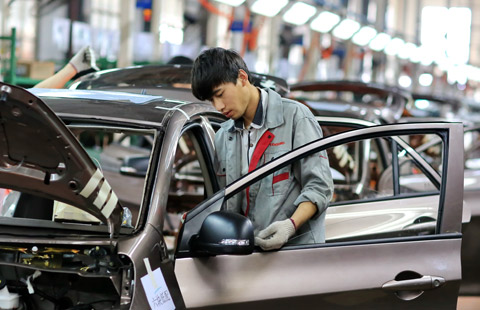
It is, of course, inevitable that as China moves from a focus on export-led growth, it will have to address structural issues, such as restrictions on labor mobility and private credit. In recent years, under the first wave of modernization, China's progress to middle-income status has been astounding and dramatic. In the first decade of the century, China became the world's largest manufacturer. In 2009, China surpassed Germany as the world's largest exporter. In 2010 it passed the US to become the world's largest car producer. But already, even before this next stage of modernization - diversification - is underway, China is gradually reducing its role as a processor of lower-value-added technological goods. As a share of national income, services have just overtaken manufacturing, and since 2011 consumer spending has been a bigger driver of growth than investment. In the future, China will depend less on exports to the West. In the last 10 years, merchandise exports to developing economies have already doubled, to 25 percent. And China is now sending capital around the world. Its portfolio of $110 billion in loans since 2000 rivals that of the World Bank.
For 35 years, China's export-led growth - almost 10 percent annually - has been spectacular, lifting 500 million Chinese out of poverty. But as the World Bank "China 2030" report acknowledged (in conjunction with China's economic ministry), productivity per worker and income per head are still far below America's, so the second wave of modernization must break China out of that feared potential "middle-income trap." Typically, a country's growth slows as soon as its income is among the top 30 percent in the world. This slowdown occurs because as a country's income rises, it is no longer able to compete on low wages, and it is unable to compete on value-added because of low productivity. Indeed, the China 2030 report forecasts the loss of 80 million of China's 130 million manufacturing jobs to lower-wage Asia and Africa.
Despite international worries - most recently about both off-balance-sheet debt and the impact of the withdrawal of the West's quantitative easing - China's leadership believes it can beat the odds. Many economists, like Ruchir Sharma, author of Breakout Nations, believe that within fifteen years China will make it to a $20,000 average per capita income by combining its current manufacturing dominance with its future role at the geographic center of a global supply chain.