Comments
  Print
Print  Mail
Mail  Large Medium Small
There are good reasons for the size of China's foreign reserves, which since 2000 have ballooned into the world's largest. Although China is the world's largest importer of soybeans and iron ore, the country's industrial processing, carried out mostly for large foreign multinationals by the huge, hard-working and skilful Chinese labor force, still dominates its foreign trade. This fact makes China's trade surplus quite insensitive to rises in the value of the yuan because of the large import content (of raw materials and components) in China's exports.
Per head of population, China's foreign reserves are smaller than those of several other major surplus countries, such as Japan, the Middle Eastern oil exporters, Norway and Singapore, but China's capital needs for modernization over the next 50 years are much larger. Although much of these needs will be borrowed on the international markets, or invested by foreign companies, China needs to preserve its capital strength to underpin its long-term development. Its large foreign reserves bring China credibility in the world's financial markets. Their successful management is of critical importance to China.
China Investment Corp, China's sovereign wealth fund, of which the headquarters are in Beijing, was set up six years ago with the aim of investing part of China's foreign reserves abroad as well as holding the country's equity interests in its most important financial institutions, including the four major Chinese commercial banks and China Development Bank. CIC was initially funded with $200 billion, by way of a complicated accounting transaction involving several Chinese central government agencies including the Ministry of Finance, the Peoples' Bank of China, and Agricultural Bank of China. In 2010, the creation of CIC International with responsibility for investing CIC's overseas portfolio simplified and strengthened the corporation's structure. By the end of last year it held a total of $569 billion in assets, of which about $190 billion was managed in a global asset portfolio by CIC International.

CIC's function is to enhance, in purchasing power terms, the value of the assets under its management, subject to ensuring their safety, and maintain liquidity sufficient to meet CIC's running costs and investment criteria. In July, CIC reported a return on its foreign-invested portfolio last year of 10.6 percent. The average annual return over five years on the overseas portfolio that it has managed since beginning its operations on Sept 27, 2007, is 5.02 percent. This equates to a five-year total return of 28 percent.
Is this return satisfactory? Since 2007, asset markets have been volatile, with the US financial crash of 2008 followed by the European crisis, which gripped markets late in 2010 and was the main reason for the return on overseas assets by CIC in 2011 of -4.3 percent. By comparison, in the past five years, the total return on the Morgan Stanley world equity index has been only 1.5 percent. The Shanghai equity index has produced a return of -2.6 percent. The performance of these investment benchmarks places CIC's returns in a favorable light, especially given the young age of the institution.
CIC has a mandate to increase or at least maintain in spending power terms the value of the assets entrusted to it. Its most important tool for managing the conflict between value loss and value appreciation is to diversify investment by different types of asset, from cash, stocks and bonds to real estate, private equity and commodities, by geography, and by manager. CIC manages about one-third of its assets itself and uses carefully selected external managers for the rest. Asset diversification increases overall financial return for the amount of investment risk that CIC takes. Since 2010 CIC has emphasized long-term investment as well as diversification, investing 32 percent of its managed assets in direct, minority holdings in foreign energy, mining, industrial and public utility companies worldwide. These purely financial, non-operational investments are intended to produce a growing stream of dividends that should keep pace with China's rise in living standards, while meeting CIC's own cash needs to cover its running costs and pay the annual interest on bonds that it sold in 2007 to China's Ministry of Finance in return for its starting capital.
In the future, CIC is likely to maintain its focus on long-term investment and diversification. The developing world will continue to grow much faster than the developed world. CIC may find that more of its opportunities for direct investment occur in Africa, South America, and Southeast and Central Asia. Increasing the proportion of direct investments in emerging-market companies will increasingly involve the CIC in South-South investment. This will strengthen China's role as an important financial player in many smaller emerging countries and, in turn, reinforce China as the principal global economic hub for bringing together and uniting the developed and developing worlds.
The author is a visiting professor at Guanghua School of Management, Peking University.
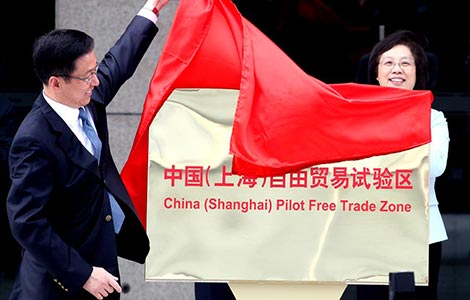 Shanghai inaugurates Free Trade Zone
 New BMW 5 Li hits Chinese market
 China to officially launch Shanghai FTZ on Sept 29
 Time to get smart
 Leaders' car picks around the world
 Shining models at 15th Aviation Expo China
 2013 Beijing Intl Jewelry Expo kicks off
 Microsoft revamps Surface to challenge Apple
Copyright 1995 - . All rights reserved. The content (including but not limited to text, photo, multimedia information, etc) published in this site belongs to China Daily Information Co (CDIC). Without written authorization from CDIC, such content shall not be republished or used in any form. Note: Browsers with 1024*768 or higher resolution are suggested for this site.
License for publishing multimedia online Registration Number: 20100000002731