

 Comments
  Print
Print  Mail
Mail  Large Medium Small
Countries are now working to get back to free trade and focusing on regional agreements to do so. APEC in itself is a giant regional grouping that accounts for 55 percent of global GDP and 44 percent of global trade. Although not based on a trade agreement, the goal of APEC since it was founded in 1989 is trade liberalization. Tariffs in APEC members have dropped from an average of 15 percent in 1994 to 5 percent this year.
An ASEAN summit in Brunei immediately after the APEC meeting underscored this shift toward regional — rather than global — free trade. The summit included leaders from across ASEAN as well as a host of other countries with which ASEAN has free trade or wants to have it.
China's Premier Li Keqiang was on hand. He held a series of meetings with Brunei's Sultan Hassanal Bolkiah and called for negotiations for the proposed Regional Comprehensive Economic Partnership (RCEP) to be completed quickly, ideally by 2015. China and ASEAN, he said, should expand free trade and boost trade to $1 trillion by 2020.
The RCEP is a proposed trade agreement that would include ASEAN along with China, Australia, New Zealand, India, Japan and South Korea. ASEAN already has free trade agreements (FTAs) with all these countries. First proposed in 2011, the bloc would represent 49 percent of the global population and about a third of global economic output, 29 percent of global trade and 26 percent of global foreign direct investment.
All this talk to speed up the development of free trade in the region should be good news for Asian countries. Regional trade is definitely getting freer and is a priority for leaders across the region.
"The (Indonesian) economy is mainly backed by relatively strong investment … from countries we have free trade agreements with," said Wirjawan during the APEC CEO Summit.
"Taiwan, South Korea, the Chinese mainland, Japan: Those are the early (economies) to sign free trade agreements with anybody in the world because they have a very strong supply side narrative."
Studies by the Asian Development Bank Institute (ADBI) suggest few countries are willing to unilaterally liberalize trade or lower tariffs without some kind of reciprocity, so a multilateral push towards free trade should be welcome — and it has been.
The number of FTAs among countries in the region has skyrocketed in the past decade. With 20 FTAs in place at the end of 2012, Singapore has the most agreements of any country in the region. China had 12 at the end of 2012, compared with one in 2000. Indonesia had nine, versus one at the turn of the century.
ASEAN is key to freer regional trade. Although progress is not always fast, the bloc still intends to launch the ASEAN Economic Community by 2015. Members are already working to streamline regulations and unify red tape, working under the idea that better governance should lead to more trade.
Freer trade can spur regional economic integration, said Hiromasa Yonekura, chairman of Sumitomo Chemical, who called on APEC members to build a trade system in the region while strengthening supply chains so that goods, services, people and capital can move across national borders more smoothly and efficiently.
 World's first 1-liter car debuts in Beijing
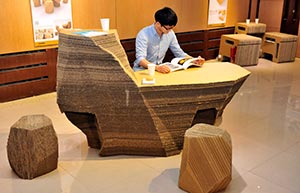 Paper-made furniture lights up art show
 Robots kick off football match in Hefei
 Aerobatic team prepare for Aviation Convention
 China Suzhou Electronic Manufacturer Exposition kicks off
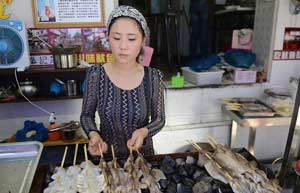 'Squid beauty' and her profitable BBQ store
 A day in the life of a car model
 Vintage cars gather in downtown Beijing
Copyright 1995 - . All rights reserved. The content (including but not limited to text, photo, multimedia information, etc) published in this site belongs to China Daily Information Co (CDIC). Without written authorization from CDIC, such content shall not be republished or used in any form. Note: Browsers with 1024*768 or higher resolution are suggested for this site.
License for publishing multimedia online 0108263 Registration Number: 20100000002731