Comments
  Print
Print  Mail
Mail  Large Medium Small
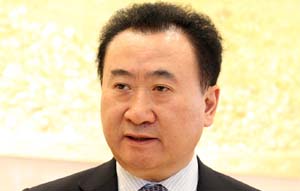
The next five to seven years will be a crucial period for implementing the profound reforms Chinese leaders pledged more than a week ago, according to a top executive at a China-based investment company.
If the pledged reforms cannot be reached by 2020, China's mid- to long-term economic outlook will face "a big discount", said Fred Zuliu Hu, chairman of Primavera Capital Group.
Many reforms were carried out over the past 35 years using "gradualism", but "Big Bang" reforms are not suitable for China, Hu said.
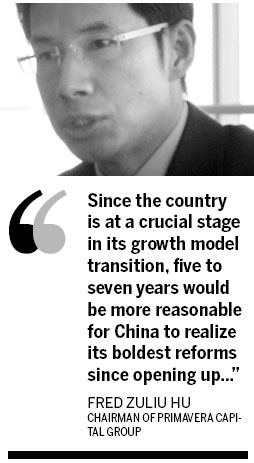
"Since the country is at a crucial stage in its growth model transition, five to seven years would be more reasonable for China to realize its boldest reforms since opening up at the beginning of the 1980s," said Hu, who is the former Greater China chairman for Goldman Sachs Group as well as a former economist at the International Monetary Fund.
The government unveiled a 60-point reform blueprint after the Third Plenum of the 18th Central Committee of the Communist Party of China in mid-November.
The plans are expected to make sweeping changes in the economy and social arenas. The 22,000-word document outlined reform tasks that cover such aspects as loosening the one-child policy, pushing forward judicial independence, making it easier for rural Chinese to migrate to urban areas and allowing markets to play a greater role in the economy.
On the economic front, the highlight is that the market should play a "decisive" role in allocating resources. Many previous policy statements described the market as playing only a "basic" role.
The significance of these reform plans, if executed properly, would be on par with that of the reforms and opening up after the Third Plenum of the CPC's 11th Central Committee in 1978, Hu said.
As opposed to those reforms, however, this round will require more extensive research and more complicated techniques, Hu said.
The Chinese economy largely stagnated before the founding of the People's Republic of China and was further disrupted by the "cultural revolution" from 1966-76.
"At the end of the 1970s, the economy was almost on the verge of collapse. So, a lot of reforms were like 'low-hanging fruit', which didn't require a complicated systemic design but had revolutionary impact," Hu said.
A key part of late leader Deng Xiao-ping's reforms was the household responsibility system initiated at the start of the 1980s. The system allows farmers to send taxes to the State and collective reserves to local governments while keeping the rest of the produce for themselves. The system spurred farmers' production initiatives and greatly increased agricultural output. Not only did it enhance rural productivity, it also turned out to be a major breakthrough in rural reform. "But the situation is more complicated now," Hu said.
Each reform, no matter whether in financial or fiscal policies, will require profound study and demand sophisticated analysis, decisionmaking and implementation, Hu said.
"Policy actions and implementations will be the key to the success of these reforms," Hu said, adding that he is "cautiously optimistic" about the outcome.
Despite all the possible thorny challenges, Hu said, his confidence stems from the fact that the dividend from the last round of reforms, which allowed the economy to maintain an annual growth rate of more than 10 percent, is diminishing. The economy is showing signs of spluttering under the weight of industrial overcapacity and unbalanced growth.
"It was still OK for some reforms to be delayed during that period, when the economy was growing by double digits each year. But now, the Chinese economy is at a stage where many long-delayed policies must be urgently accelerated," Hu said.
Second, the current leadership has facilitated reforms and shown toughness in advancing complex changes, which is a sign that "they truly believe in deepening reforms," Hu said.
The third factor, he said, will very much depend on a high-level group to lead the reforms, Hu added.
A communique unveiled after the closing of the four-day plenum said China will set up a specialized, high-level group to design and coordinate the country's reform and opening-up. The team is likely to be more powerful than a former ministry-level economic reform commission, which shut down thousands of inefficient State-owned firms in the 1990s, analysts said. "This team will likely provide assurances to counter resistance and push forward the reforms," Hu said.
 Jimmy Lin Zhiying, models at Toyota pavilion
 Volvo all-new S60L world premiere at Guangzhou auto show
 Largest span timber arch bridge
 Porsche 911 Turbo S Asian premiere fascinates Auto Guangzhou
 Auto Guangzhou witnesses new Porsche sports cars Asia Premiere
 2013 Guangzhou auto show carmakers' eventers
 Models at Volvo pavilion at 2013 Guangzhou auto show
 Lexus new hybrid hatch CT200h world premiere in Guangzhou
Copyright 1995 - . All rights reserved. The content (including but not limited to text, photo, multimedia information, etc) published in this site belongs to China Daily Information Co (CDIC). Without written authorization from CDIC, such content shall not be republished or used in any form. Note: Browsers with 1024*768 or higher resolution are suggested for this site.
License for publishing multimedia online 0108263 Registration Number: 20100000002731