Comments
  Print
Print  Mail
Mail  Large Medium Small
Chinese producers take the less traveled road in Africa and Europe for sustained growth, as Todd Balazovic and Li Aoxue report.
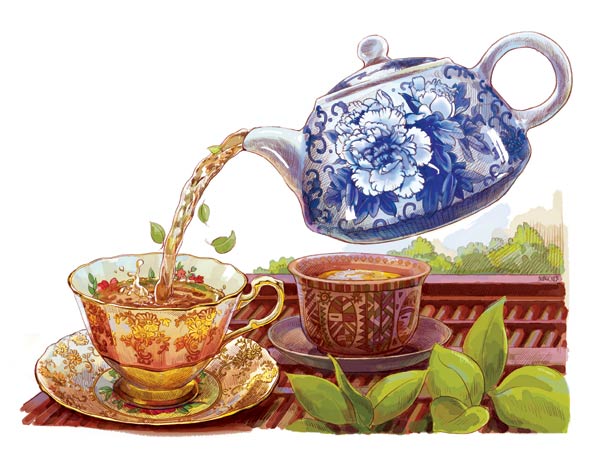 |
|
Song Chen / China Daily |
What started 5,000 years ago with a haphazard gust of wind dropping foliage into the boiling pot of a wandering Chinese emperor has brewed into a cultural cornerstone worth billions in any currency.
China may be the world's largest tea producer — growing about 2 million tons annually — but international demand for leaves from the country best known for its exports is a fraction of what it produces, with most of the quality product sold domestically.
Although it accounts for more than 40 percent of the tea produced in the world every year, China exports a tiny fraction of the annual crop yield.
Tea producers from countries such as Kenya, India and Sri Lanka dominate the global export market, producing mid- to low-quality teas for mass consumption in the US and Europe.
The reason for China's small portion of the pot is simple — for Western drinkers unaccustomed to the sophisticated process of fine tea appreciation, the price tag of Chinese tea is too steep.
"There is a culture behind Chinese tea that is not found in the West," said Li Zongjian, founder of Lijiang-based tea producer Li Liang Xi, at the recent China Tea Expo in Beijing.
Li, who earned his degree studying the ceremony, growing process and health benefits of tea, says much more goes into Chinese tea than simply creating and consuming.
Perched on a bamboo stool before a meticulously carved wooden serving table, Li is eager to prove his point, theatrically clinking together heated cups as he prepares for a Chinese tea ceremony.
Carefully pinching a dark chunk of Pu'er tea, fermented black tea leaves made famous by China's southern Yunnan province, he holds them under his nose, inhaling deeply.
With a look of satisfaction, he begins preparing the leaves in the way most of the Western world is familiar — boil water, add tea.
But before the brewing process is complete, Li dumps the entire pot of $150 tea into a hidden drain on his serving table — evoking the obvious question "What was the reason for that?"
The first boil only works to awaken the tea leaf, he explains.
This takes place two more times before he serves what he has deemed an appropriate cup of tea according to the gongfucha serving method he spent years perfecting.
"When Chinese people drink tea, they don't consume it like a product. We have tea as a part of our culture, so the standard is high," Li says, continuing his showmanship with an exaggerated sip from the steaming glass.
"For Westerners, it's simply a beverage."
Although it's hard to put a price on culture, Li can sell 100 grams of his hand-picked teas for between $100 and $1,500, depending on the age of the leaves and method by which they were grown — compared with $28 for the same quantity of popular UK tea brand Twinings.
 Buick Riviera concept car at 2013 Auto Guangzhou
 FAW-VW all-new Golf at Guangzhou auto show
 VW donates more than 5k child safety seats
 Honda models at 2013 Guangzhou auto show
 Honda Jade at the 2013 Guangzhou auto show
 Toyota's new Reiz debuts at 2013 Auto Guangzhou
 Jimmy Lin Zhiying, models at Toyota pavilion
 Volvo all-new S60L world premiere at Guangzhou auto show

Copyright 1995 - . All rights reserved. The content (including but not limited to text, photo, multimedia information, etc) published in this site belongs to China Daily Information Co (CDIC). Without written authorization from CDIC, such content shall not be republished or used in any form. Note: Browsers with 1024*768 or higher resolution are suggested for this site.
License for publishing multimedia online 0108263 Registration Number: 20100000002731