Comments
  Print
Print  Mail
Mail  Large Medium Small
|
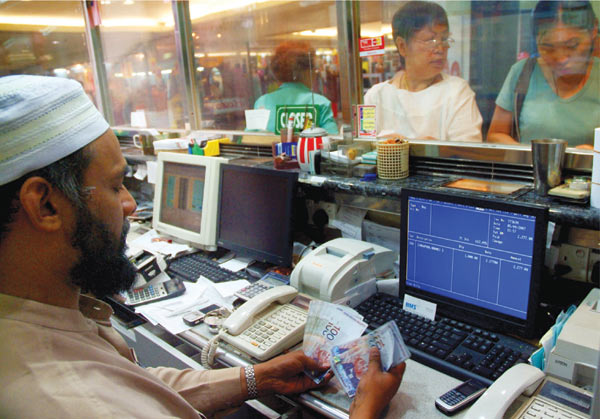 A money changer counts Malaysian ringgit notes for customers at a foreign exchange booth in Kuala Lumpur. Malaysia has a weak yuan onshore settlement performance because of a lack of public and market awareness and a dependency on US dollar-denominated trading. [Photo / Agencies]
|
Internationalization of the yuan is taking major strides towards becoming a reality. As China's biggest partner in the region, Malaysia needs to prepare itself for this eventuality, and increase the percentage of its trade with China that is settled in yuan.
According to a report released by the Bank for International Settlements in September, the yuan jumped from the 17th spot in 2010 to the ninth most actively traded currency in the world. The key lies in expansion of offshore trade.
In a report by HSBC, yuan usage is predicted to account for an estimated $2 trillion in 2015, which will catapult the currency to becoming the third largest trading currency after the dollar and the euro.
Compared with the dollar, euro and yen - currently the world's top three most traded currencies - the market share of the yuan remains small. However, the rapid growth of yuan offshore trading proves the currency is on track for internationalization.
The issue of yuan internationalization has become imperative as global factors are taken into account. Examples include the debt crisis in the United States and European Union; global monetary easing policies; the weakening of traditional international currencies and an insufficient supply of gold and other precious metals.
But, is the yuan prepared to internationalize?
Even with favorable statistics and an encouraging global economic background, the Chinese government and central bank still need to do more comprehensive and systematic planning.
This planning includes: expanding the offshore yuan settlement market; unleashing yuan cross-border settlement to all industries; enlarging currency swaps and links with trading settlements; encouraging yuan-denominated trading financing and improving the Chinese financial market system.
No time frame was provided for the yuan's internationalization at this month's third plenum by the Chinese Communist Party, but there is no doubt China wants it to become a major global currency. This intention was clearly shown in the report of the third plenum.
Assuming that yuan internationalization is forthcoming, the question arises: Can Malaysia, China's biggest partner in the region, benefit from this?
In September 2011, Bank Negara Malaysia appointed Bank of China Malaysia as the yuan Onshore Settlement Institution. The real time settlement system operated in 2012, with 11 financial institutions joining the service, including Maybank, CIMB and Public Bank among others.
The service enables trade settlement in yuan between businesses in Malaysia and China, as well as yuan funds transfer via the electronic transfer system.
Since onshore settlement services started in mid-2012, after nearly one-and-a-half years, statistics show that the proportion of Malaysia enterprises using the yuan settlement is only about 1 percent of total bilateral trade.
As Malaysia-China bilateral trade accounted for $94.8 billion last year, the usage of yuan onshore settlement came to just around $1 billion. Malaysia and China signed a 180 billion yuan ($29.4 billion) currency swap agreement in 2012.
Then, during Chinese President Xi Jinping's visit to Kuala Lumpur last month, both country leaders expressed the intention to expand the size of the currency swap. As Malaysia and China look to expand the bilateral trade to $160 billion by 2017, this undoubtedly reflects the likelihood that bilateral trade will be more frequent than before.
With bilateral trade and the amount of currency swap on the increase, can this translate to the increasing use of yuan onshore settlements for Malaysia's enterprises?
From Anbound's observations, the reasons for poor yuan onshore settlement performance in Malaysia mainly come from two aspects. First, there is the lack of public and market awareness and poor understanding of yuan settlement system services. Although the onshore settlement system was launched in Malaysia in 2012 with most of the big financial institutions joining the system, the related awareness campaign did not catch on. Also, details of onshore settlement services were not widely reported in the media.
Second, the US dollar is still widely used in Malaysian international trades, with many industry players believing dollar-denominated trade is more convenient and cheaper than using other currencies. Malaysian companies still prefer to use the dollar when trading with China, as they would with other trading partners in the US and EU. Trading in a single currency also allows firms to avoid complications in accounting.
Fung Vun Ket is an analyst at the Kuala Lumpur office of Anbound Research, one of the largest independent think tanks on the Chinese mainland.
 Model with modified Audi A5
 Model with German luxury cars
 Getting in the mood
 Models at Mercedes pavilion at 2013 Auto Guangzhou
 Buick Riviera concept car at 2013 Auto Guangzhou
 FAW-VW all-new Golf at Guangzhou auto show
 VW donates more than 5k child safety seats
 Honda models at 2013 Guangzhou auto show
Copyright 1995 - . All rights reserved. The content (including but not limited to text, photo, multimedia information, etc) published in this site belongs to China Daily Information Co (CDIC). Without written authorization from CDIC, such content shall not be republished or used in any form. Note: Browsers with 1024*768 or higher resolution are suggested for this site.
License for publishing multimedia online Registration Number: 20100000002731