

SHENZHEN - Several new high-speed railway links in China are expected to start operations by the end of 2013, extending the ?network to over 12,000 kilometers, more than half of the world total.
"We are looking forward to the new line," said Xie Fugui, a businessman in the southern city of Guangzhou. "Most of my suppliers are from Chaozhou, and it takes me at least six hours to go there by coach, but the new railway will cut my travel time by half."
Xie was talking about the Xiamen-Shenzhen line between the port of Xiamen in east China's Fujian Province, and Shenzhen, China's first Special Economic Zone. Travel time between the two cities shortened from 13 hours to four hours as it opened on Saturday.
The 513 km line extends east to Shanghai and westward to Guangzhou, significant business hubs.
It is the last link in the chain between the most dynamic cities and manufacturing centers in east and south China, with a population over 700 million, and almost as large as Europe.
"We can now invite foreign buyers to visit our plants in Chaozhou. Many of them are interested in such visits, but few were willing to waste so much time," Xie said.
Thanks to the new line, Xie can visit his parents in Fujian more often, as the trip is now much easier and cheaper. Tickets for a second-class seat from Shenzhen to Xiamen, further than the distance between New York and Montreal, costs only 150 yuan (25 U.S. dollars).
Others pin hopes on the capital and intellectual flows which the new railway will bring, essential to the development of millions of small and medium enterprises(SMEs) along the southeast coast.
"Convenient transport will stimulate SMEs, and strengthen the links between the economic engines," said Long Guanghui, director of DTZ Shenzhen.
The "engines" Long refers to are the Yangtze Delta, the Pearl River Delta, and the Western Taiwan Strait Economic Zone, which are connected by several high-speed rail links now, and may turn into a world-class urban belt on a par with the northeast coast of the United States, or the Seto Inland Sea of Japan, according to Chen Hongyu, counselor of Guangdong provincial government.
Other new high-speed rail lines which began services on Saturday include one in the northwestern province of Shaanxi, starting point of the ancient Silk Road, and another in south China's Guangxi Zhuang Autonomous Region, the bridgehead of China-ASEAN cooperation.
Along with the development of domestic high-speed rail, the government and rail enterprises are actively seeking overseas customers.
Stepping out of shadow
The first Chinese "Harmony" high-speed train pulled out of the station in April 2007. Six years and five months later, the world's second largest economy has built the world's biggest high-speed rail network. It was a short time and full of ups and downs.
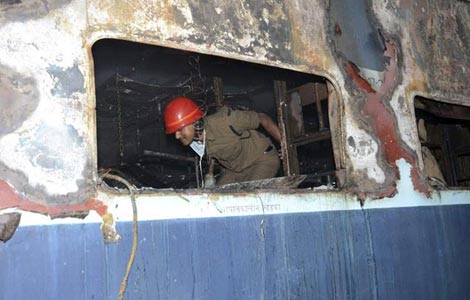
Huge shadow was cast in 2011 when a crash claimed 40 lives in east China. Since then, a series of corruption scandals have brought about the arrest of the former railways minister, Liu Zhijun, on charges of corruption and abuse of power.
"About 95 percent of construction projects were suspended after the incidents," said Deng Hanquan, a construction supervisor on the Xiamen-Shenzhen Railway, initially planned for completion in 2011. Many people both at home and abroad questioned the whole strategy of high-speed rail.
"The former railways ministry was a mixture of administrative and commercial operations and a monopoly. It was a hotbed of corruption," said Xiao Jun, a professor at Shenzhen University. "Besides investigating the accident and scandals, the government has taken action to solve institutional problems."
The ministry was split into administrative and business arms in March.Responsibilities for planning and policy were taken over by the state railways administration under the Transport Ministry, while the China Railway Corporation (CRC) was established to deal with commercial concerns. Liu Zhijun was sentenced to death with a two-year reprieve in July.
The cabinet issued a new document in August to "reform the investment and financing system of railways and to accelerate railway construction." The CRC then revised the annual construction plan. The number of new projects for 2013 increased from 38 to 47, and all blueprints had to be complete by the end of October.
"Construction gradually resumed and now we are back in the fast lane," Deng Hanquan said.
Xiao Jun believes that what happened in the high-speed rail sector proves that fighting corruption will not hamper economic development.
"On the contrary, it is the zero-tolerance of corruption and the improvement of systems that restored public confidence in the industry," Xiao added.
He stressed that the world's largest constructor and operator of high-speed rail must continuously eliminate institutional flaws, carry on the separation of government and enterprise, and enforce supervision of investment in the public sector.
Problems remain
Problems such as a high debt-to-asset ratio and the monopoly are still challenging.
The CRC's debt-to-asset ratio had climbed to 63 percent by the end of the third quarter of 2013. Its total assets were 4.84 trillion yuan (800 billion U.S. dollars), and its debts amounted to 3.06 trillion yuan.
These hefty debts are part and parcel of the high-speed boom.
China's rail construction are mainly government funded. The former ministry once introduced policies to encourage civil investment, and promised to protect investors' interests, but market insiders are calling for more specific rules.
"Some projects have spent years in financing but still can not get off the ground," Deng Hanquan told Xinhua. "The government encourages private businesses to lay money in the rail sector. But the industry has high demand on capital. Few companies are capable of providing so much money and it is hard for them to cover costs."
Wang Mengshu, a railway expert at the Chinese Academy of Engineering, suggested that the government should declare a clear scheme of profit distribution to attract private capital.
Experts also criticize the closed operation and incomplete marketization of high-speed rail, urging the CRC to launch further reform and be subject to public supervision.
|
|
|
|
|
|
|
|

Copyright 1995 - . All rights reserved. The content (including but not limited to text, photo, multimedia information, etc) published in this site belongs to China Daily Information Co (CDIC). Without written authorization from CDIC, such content shall not be republished or used in any form. Note: Browsers with 1024*768 or higher resolution are suggested for this site.
License for publishing multimedia online 0108263 Registration Number: 20100000002731 
















 Op Rana
 Berlin Fang
 Zhu Yuan
 Huang Xiangyang
 Chen Weihua
 Liu Shinan