|
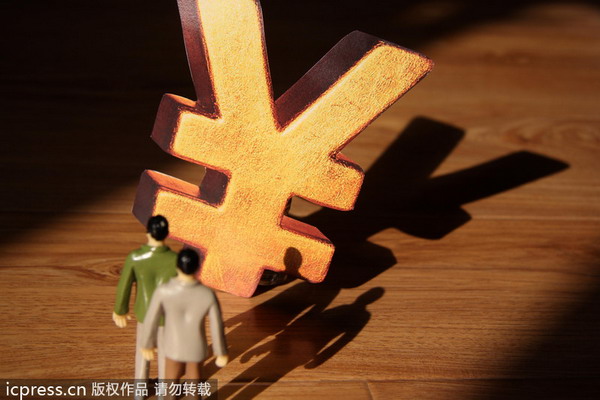 The China Securities Journal reported on Tuesday that the central government has issued a document aimed at clarifying the characteristics of shadow banking as well as how it intends to regulate the non-bank financial services running rampant in China in recent years. [Photo / icpress.cn] |
Beijing seems to have gotten serious about so-called shadow banking, which has blown up social financing and run against its stated wish of deleveraging the transforming economy.
Shadow banking, which broadly refers to financing activities done outside normal banking channels, has been awash in media coverage and research reports for quite some time, but the term is often interpreted in various ways, and Beijing has given no word yet on what it believes the multitrillion-yuan industry really entails.
But global investors fear that China's shadow banking creates risks reminiscent of the US subprime-mortgage boom that led to a worldwide financial crisis. In the US' case, many financed projects were never paid off, nor was it fully disclosed what investors were being asked to fund.
But for shadow bankers in China this week, things may be about to get real, as Beijing seems to have decided to offer a definition.
The China Securities Journal reported on Tuesday that the central government has issued a document aimed at clarifying the characteristics of shadow banking as well as how it intends to regulate the non-bank financial services running rampant in China in recent years.
The newspaper quoted anonymous sources as saying that the document details specific regulatory responsibilities across government departments and has divided shadow banking entities into three separate categories.
The first type is unlicensed and unregulated financial intermediaries, including Internet financial platforms and third-party asset management agencies.
The second is made up of intermediaries who have a license but are insufficiently regulated, such as underwriters and micro-credit companies.
The last category covers licensed financial entities with part of their businesses being insufficiently regulated, such as money market funds, asset securitization and asset management.
Beijing reportedly asked the People's Bank of China, the central bank, to set up a special team to gather and generate shadow banking-related information.
At the moment, market opinion differs on the scale of shadow banking activities, with estimates ranging from hundreds of billions to many trillions of yuan.
The report said the PBOC has been told to regularly brief the State Council, the Chinese cabinet, on the issue.
James Xi, general manager of a third-party wealth management institution in Shanghai, said he had noticed the document online, which has been circulating among industry insiders.
"It seems that it did not provide specific supervision measures on third-party wealth management institutions.
"But by including it in a category of shadow banking in such an official document gives a signal that the authority is going to do something to manage this sector," he added.
An official with the PBOC told China Daily on Tuesday that he could not confirm the existence of the document.
And the China Banking Regulatory Commission told China Daily that "we haven't received the document yet, but we have noticed related media reports".
In what seems to be a campaign on shadow banking, the commission posted a statement on its website on Tuesday vowing to "clear up" the non-financing underwriters that normally provide guarantee services to industrial projects.
Some of the underwriters, according to the statement, have illegally engaged in fund-raising and lending, both of which fall within the realm of shadow banking.
Last year, JPMorgan Chase Co estimated that the value of China's shadow banking totaled $6 trillion.
China's latest audit of local government debt tallied shadow banking at 17.9 trillion yuan ($2.96 trillion) by the end of June, up 67 percent from the 10.7 trillion yuan at the end of 2010.
Copyright 1995 - . All rights reserved. The content (including but not limited to text, photo, multimedia information, etc) published in this site belongs to China Daily Information Co (CDIC). Without written authorization from CDIC, such content shall not be republished or used in any form. Note: Browsers with 1024*768 or higher resolution are suggested for this site.
License for publishing multimedia online 0108263 Registration Number: 20100000002731 

