A growing urban population and changing diets are causing short supplies of the staples and pushing up consumers' costs, Zheng Yangpeng reports
At the year-end conference of the National Development and Reform Commission, Chairman Xu Shaoshi was talking about ensuring stable prices when he suddenly switched to the topic of meat.
"The most urgent shortages involve beef and mutton. Prices are rising quickly, and in some areas, you can't buy these meats, no matter what you're willing to pay," he said.
He said that the NDRC, the nation's top economic planner, had spoken with the Ministry of Commerce about arranging emergency imports of 200,000 metric tons of meat.
In September, the NDRC said it would invest 1.7 billion yuan ($278 million) to develop large domestic beef and mutton producers.
Starting from about 2006, the cost of raising cattle soared and squeezed farmers' profit margins. Cattle yards began to cull their cows and seek alternatives, such as raising pigs.
Since then, beef has been in short supply in China. Rising domestic prices of beef and mutton have pushed the country to seek them abroad.
According to the US Meat Export Federation, China's beef imports in the first 10 months of 2013 totaled 253,196 tons, compared with just 38,251 tons in 2012.
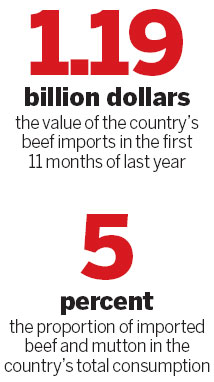
In the first 11 months of 2013, China imported 282,400 tons of beef, valued at $1.19 billion, rising 413.5 percent and 446.8 percent year-on-year respectively; and imported 237,800 tons of mutton, valued at $874 million, increasing 112.1 percent and 127.6 percent year-on-year respectively. And the proportion of imported beef and mutton accounted for about 5 percent of the total consumption in the country, according to statistics released by the Ministry of Commerce on Thursday.
But experts said last year's spike was special and wasn't likely to persist.
Pan Chenjun, an analyst with Rabobank International, said that in 2013, the government eased restrictions on some previously banned meat imports. As a result, previously "illegal" imports moved into the columns of official data. Pan said that was the main reason for the surge.
China has banned US beef since a mad cow disease scare in 2003, although US beef still showed up on Chinese tables because of smuggling or imports via third countries.
At technical trade talks in Beijing on Dec 23, Chinese officials promised to ease restrictions on US beef, without a definite timetable.
Pan said China's beef imports are likely to rise 30 percent annually in the next few years. Imports could double by 2018, and that, she said, is the "most conservative estimate".
Two major factors are driving China's beef imports: urbanization and a changing diet structure, experts said.
Copyright 1995 - . All rights reserved. The content (including but not limited to text, photo, multimedia information, etc) published in this site belongs to China Daily Information Co (CDIC). Without written authorization from CDIC, such content shall not be republished or used in any form. Note: Browsers with 1024*768 or higher resolution are suggested for this site.
License for publishing multimedia online 0108263 Registration Number: 20100000002731 

