|
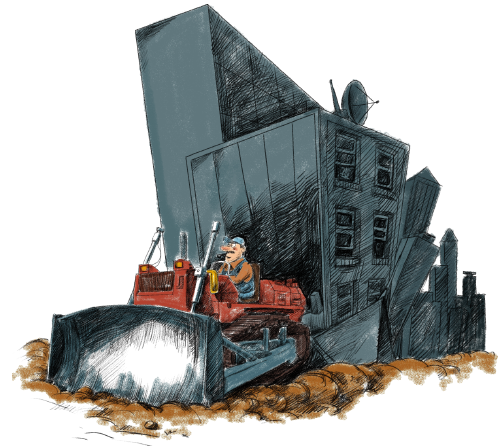 [Photo / China Daily] |
Giving local governments the right to sell bonds will help relieve debt burden and improve transparency
Although urbanization has been an essential ingredient in China's growth and development over the past 30 years, the transformation to a predominantly city-based nation brings with it societal ramifications and financial implications.
Most of the issues that confront China's urbanization process deal with financing costs and methodologies for sustainable economic development. Given China's economic model and history of centralized planning, one would expect the central government to play a key role in supporting local government budgets.
In reality, however, the central government has provided only limited financial support to local governments, leaving the job mostly to local government officials and the city leadership, for example. the Party secretary and mayor.
These leaders are responsible for managing the ongoing urbanization process in their city, identifying sources of capital and utilizing funds needed to pay for projects such as housing, schools, transportation links, hospitals, utilities and infrastructure.
At the same time, however, local officials have faced considerable constraints that have limited their funding options. The ability to generate funds from local taxation is one of them.
A large portion of taxes collected locally is sent to the central government, with only a small portion retained or redistributed at local levels. Further, although local governments can impose and collect fee-based income from businesses - such as pollution charges and betterment fees from developers, in recognition of the burden their projects impose on the public infrastructure - these fees are currently assessed at very low levels.
As a result, most funding for urbanization at the local level has come from two sources: debt from banks and land sales. Land sales are not actually sales of land, per se, because the government retains ownership of the land. City governments collect the funds directly from developers and use those revenues to build roads, schools and other municipal projects.
Although China is a large country, there are obvious drawbacks to such a system. For example, land can generally only be sold once (or at least infrequently - land leases are typically of 40 to 70 years in duration). In some eastern locations in China, where the development processes are more advanced, governments are already running low on land.
The second source is debt, which has to date primarily been through bank loans, and emerging measures such as the issuing of local bonds. Technically, Chinese local governments may not borrow directly from banks. Despite this limitation, many have found ways to access bank funding using municipal investment entities known as urban development investment corporations (UDICs). The popularity of taking on debt to fund local projects has been increasing in the last four years, because the central government in Beijing has maintained relatively loose monetary policies.
As many as 8,000 UDICs now exist. They account for between 80 to 90 percent of debt-funded urban infrastructure spending. Total local government debt is now approaching 20 trillion yuan ($3.3 trillion), and concerns have been raised over the sustainability of such debt levels and structures, with repayment timeframes often not well matched to the underlying asset.
Despite rapid urbanization in the past 30 years, China still has decades of urban construction and development ahead. The ability of China's cities to finance expanded public services and infrastructure for their growing populations have critical implications for the nation's economic growth and well-being.
If funding for China's urbanization is to be put on a more solid and sustainable footing, local governments need more (and more flexible) funding options and funding models.
The first option for additional funding could come from China's progressive bond program, which was recently expanded to include six local governments. The program began in 2011, with pilot programs involving governments from Shanghai, Shenzhen and the provinces of Zhejiang and Guangdong. In July 2013, Jiangsu and Shandong provinces were also added to the list. Under the program, bonds can be issued in three-year, five-year and 10-year durations.
Analysts believe that giving local governments the right to sell bonds will help relieve their debt burden and improve debt transparency. These moves also could be viewed as a gradual transition to a new model, in which local governments have more autonomy to decide on what funding methodology fits the need of the project, thus mitigating certain market risk factors.
A second option for additional funding of urbanization projects is the use of public-private partnerships. PPPs are not unknown in China. In fact, the Chinese government has been applying a PPP scheme known as build-operate-transfer on a large scale since the 1990s.
Under the build-operate-transfer model, the government grants a private company the right to build a project and allows it to operate it for a profit over an agreed period. After the period expires, the private entity transfers the project to the government. Thus, risk is removed from the local government and transferred to the private entity for an extended period of time, along with the potential reward of the project.
China's urbanization is a long-term phenomenon - a process only partially completed. What is changing now is that local governments may be increasingly motivated to seek out new ways to finance their physical expansion, because it appears that development through land sales may have peaked, while the continuing issuance of local debt through bank loans is not sustainable.
It is now likely that funding urbanization in China will witness a period of experimentation, marked by pilot programs and incremental expansion, as opposed to dramatic and sudden policy shifts.
David Frey is a partner of KPMG China. Robert Ritacca is research manager at Global China Practice of KPMG China. The views do not necessarily reflect those of China Daily.
Copyright 1995 - . All rights reserved. The content (including but not limited to text, photo, multimedia information, etc) published in this site belongs to China Daily Information Co (CDIC). Without written authorization from CDIC, such content shall not be republished or used in any form. Note: Browsers with 1024*768 or higher resolution are suggested for this site.
License for publishing multimedia online 0108263 Registration Number: 20100000002731 

