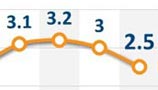
Labour cost has increased rapidly
While average manufacturing wage in China is still only a fraction of that in developed economies, it has grown at double digit rate for more than a decade. As productivity gains slowed in recent years, the continued rapid wage growth has led to a more than five percent a year growth in unit labour costs (ULC) since the global financial crisis.
RMB has appreciated by more than 30 percent since 2007
The RMB appreciated by about 20 percent against the US dollar since 2007 while many of China's competitors and trading partners saw their currency weakening. As a result, the RMB has effectively appreciated by about 30 percent. In US dollar terms, China's ULC has gained more than 60 percent since 2007, the fastest among key trading partners and competitors. The large real appreciation has led to significant adjustment in China's external balance. From an economic fundamental's point of view, the RMB is no longer undervalued.
Competitiveness has been eroded
Rising labour costs and currency appreciation have led to an erosion of competitiveness and market share in some of China's traditional export sectors such as apparels, while countries like Vietnam, Bangladesh and Mexico have gained grounds. At the aggregate level, China's gain in global market share has slowed while its shares in the US and EU have stagnated or declined.
There are also signs of China moving up the value chain.
As China lost ground on traditional labour-intensive processing trade, it has continued to gain market shares in electronics, and machinery and equipment sectors. China's role in the regional supply chain seems to be deepening as foreign companies with operations in China and other parts of Asia are increasingly sourcing their inputs from China.
Implications for growth, policy and the exchange rate
We still expect Chinese exports to benefit from stronger growth in the US and Europe in the coming year, but the magnitude will be smaller than usual due to the erosion of competitiveness. Over the medium term, China has to push forward with structural reforms to help increasing productivity and moving up the value chain. The sectors that have been more open to market competition, including from imports, are more likely to succeed in this endeavour. We see little fundamental support for continued nominal RMB appreciation and believe the government should manage capital flows more carefully to prevent large exchange rate overshooting.
There seems to be plenty of reasons to worry about China's competitiveness. The currency has appreciated significantly since the global financial crisis, recent modest depreciation notwithstanding; wage growth has averaged double digits for more than a decade; and utility costs and interest rates have been rising as well. The Chinese government has actively pursued or embraced many of these changes, in the attempt to reduce the China's reliance on export growth, boost domestic consumption, and move the industries up the value chain.
But is China still competitive as a major exporter and manufacturing power house? Which countries have China lost market shares against and in which sectors? Has China been able to move up the value chain as desired? What does this mean for economic growth and for the exchange rate going forward?

Copyright 1995 - . All rights reserved. The content (including but not limited to text, photo, multimedia information, etc) published in this site belongs to China Daily Information Co (CDIC). Without written authorization from CDIC, such content shall not be republished or used in any form. Note: Browsers with 1024*768 or higher resolution are suggested for this site.
License for publishing multimedia online 0108263 Registration Number: 20100000002731