Villages prevailed in the Communist Party of China's revolutionary discourse until the latter won the civil war over the Kuomintang by mobilizing poor farmers to besiege cities in 1949, when 90 percent of China's 500 million population was rural.
The crux of the agricultural country's urbanization today also lies in the villages. Farmers now want to enter cities after being fended off for a long time.
|
 |
|
 |
This period, especially after the "cultural revolution" (1966-76) ended, witnessed the largest, if not the most persistent, population transfer in human history within one country.
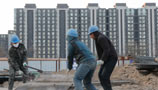
More than 200 million working-age farmers and their 70 million families have elbowed their way into cities by undertaking the least desirable jobs.
Migrant workers, who were called tramps in cities during the planned economy, are blamed for the causes of "urban maladies", while their contribution to the economy as laborers and consumers is selectively ignored.
Their odyssey is only half complete. Urban migration is far from being recognized by the government or accepted by the metropolitan class.
Fifty-three percent of Chinese live in cities now. One-third of them are migrant workers, who are denied citizen welfare rights.
The average urban pension is 20 times higher than it is in rural areas. The average personal income of Chinese farmers is less than $4 a day, one-third of their urban counterparts.
The eye-opening experiences in cities and the human impulse to pursue a better quality of life drastically change migrant workers' expectations of the government.
The first generation of migrant workers, in their early 60s today, are mostly satisfied by becoming the first person to enter a city from a village. Their sons' dreams are to bring back home as much money as possible. Their grandsons, born in the 1990s, who do not know how to go about farmwork, do not want to return to the villages anymore.
The inner tension of such divided cities is currently sizzling as large patches of farmland are turned into cities.
To some extent, abolishing the agriculture tax for farmers in 2006 and extending to the farmers the basic pension and medical care insurance network in 2009 is helping to ease the tension.
But land and hukou (registration right) remain the obstacles that cannot be bypassed in the government's pursuit of so-called new urbanization.
Paradoxically, the government had used the two factors to concentrate the war-torn nation's limited resources in its cities and urban dwellers before, on the back of the farmers' enforced sacrifice of their rightful interests.
Former fortifications become current restraints hindering the free flow of production factors.
A similar vexing dilemma is the relationship between economic growth and urbanization. The history of developed countries proves the latter is a result of the first.
In history, Chinese cities came about on fertile farmland along big rivers, grew with innovation and the convenience of transportation, prospered from openness and free trade and withered in seclusion and rigidity. China's urbanization rate, which rose from 20 percent to more than 50 percent in the past 30 years, is also a natural result of China's market reform.
But many local governments believe it works the other way around as well, with urbanization as the new consumption and investment engines of economic growth.
Putting the horse before the cart is the first thing the Chinese government should bear in mind in balancing urbanization and growth.
Otherwise, a simple land urbanization driven by the government's pursuit for growth will only move the villages into cities.

Copyright 1995 - . All rights reserved. The content (including but not limited to text, photo, multimedia information, etc) published in this site belongs to China Daily Information Co (CDIC). Without written authorization from CDIC, such content shall not be republished or used in any form. Note: Browsers with 1024*768 or higher resolution are suggested for this site.
License for publishing multimedia online 0108263 Registration Number: 20100000002731