
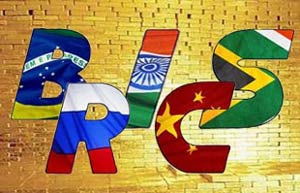
After five years of introspection and institution building, the sixth BRICS summit offers an opportunity to the group to focus on its relations with the rest of the world. Relations with the G7 are particularly contentious. Russia's exclusion from the G8 following the crisis in Crimea has moved the BRICS to the center stage in Russian foreign policy thinking, and risks pulling the group onto an opposition footing with the West.
The other four BRICS member (Brazil, India, China and South Africa) will have to decide whether they stand by Russia in its ongoing standoff with the G7, or whether they will act as a bridge to reconnect Russia to the international community. The group seemed relatively united on the issue in late March, when the foreign ministers of the five member countries issued a joint statement standing by Russia in the face of possible expulsion from the G20.
The Crimea issue is a particularly difficult point for BRICS, because solidarity with Russia seems out of line with their uniting geopolitical principle of non-intervention and negotiated problem solving. Little is expected to be made clear at the sixth BRICS summit in Fortaleza, Brazil, because the group will attempt to keep its focus on less contentious economic issues and the building of some institutional architecture, in the form of the BRICS "new development bank" and contingent reserve arrangement.
But both these initiatives pose similar questions about the BRICS' relationship with the rest of the world. Commentators have been quick to frame them as standing in opposition to the Bretton Woods system, with the contingent reserve arrangement taking on the International Monetary Fund, and the new development bank becoming an alternative to the World Bank.
Much of this is overstated. The CRA will have a far more limited mandate than the IMF, focusing on providing up to $100 billion in foreign exchange to BRICS countries that face balance of payments or short term liquidity crises. Speculation is that the NDB will be capitalized with an impressive $50 billion, but this still puts it some way behind the leading regional development banks, such as the Asian Development Bank (with $136 billion) and African Development Bank (with $98 billion). The World Bank is still well ahead, with $223.2 billion in subscribed capital.
The CRA and NDB cannot replace the existing institutional infrastructure, and they should not aim to. BRICS' new financial institutions can maximize their impact and most powerfully create change by engaging actively with the established global economic infrastructure. The BRICS institutions are already different in important ways, with the NDB, for example, having a democratic structure that differentiates it from the weighted voting in the Bretton Woods institutions. Just as Chinese development spending in Africa challenged the traditional model of extensive conditionality, so can the NDB challenge older models of assistance, while still working with established institutions.
For the BRICS institutions to play this role of norms setter, they will need to engage where the World Bank and IMF do - in regions such as Africa, Latin America and Southeast Asia. But debate still continues as to whether the NDB should focus its activities among BRICS members or out in the broader developing world. There certainly are a lot of opportunities in BRICS, and a BRICS bank operating in the five countries would still be an achievement. But it would undermine the group's influence in the rest of the developing world, and limit the group's attempts to act as an alternative center of influence in international development funding.
The Fortaleza summit will offer insights into BRICS' relations with both the developed and developing worlds, but it is the group's relationship with other major emerging countries that is most important. BRICS cannot legitimately claim to speak for emerging economies in a world in which the likes of Indonesia, Turkey and Nigeria remain on the outside.
The BRICS group is too important to ignore, but currently too small to decisively speak for tomorrow's great powers. The structure of the development bank should provide insights into the long-term future of the group's membership. Rhetoric around the bank has shifted from talk of a "BRICS Development Bank" to a "New Development Bank", and the funding model chosen - of a flat $10 billion contribution by each member country - seems intended to allow other countries to buy into the bank without complex quota renegotiations.
How easy the process of joining the NDB, and which countries would be eligible to join, should act as a bellwether for whether the BRICS members intend to stand alone in their efforts, or seek a new world order that is inclusive and cooperative.
Elizabeth Sidiropoulos is chief executive, South African Institute of International Affairs, South Africa, and Chris Wood is a researcher with economic diplomacy program, South African Institute of International Affairs.
|
 |
 |
| BRICS seeks new paths to develop | Emerging economies remain dynamic |

Copyright 1995 - . All rights reserved. The content (including but not limited to text, photo, multimedia information, etc) published in this site belongs to China Daily Information Co (CDIC). Without written authorization from CDIC, such content shall not be republished or used in any form. Note: Browsers with 1024*768 or higher resolution are suggested for this site.
License for publishing multimedia online 0108263 Registration Number: 20100000002731