Move likely to affect salaries for about 200 executives of central govt entities
The decision to cut salaries for top executives at State-owned enterprises that are directly administered by the central government is essential for wage normalization, analysts said on Wednesday.
At the same time, the reforms also indicate that deep-rooted corporate governance problems exist at these firms and more reforms are needed to correct the anomalies, they said.
The Politburo of the Communist Party of China approved plans last week to cut the hefty salaries of top executives at central SOEs. Qiu Xiaoping, vice-minister of Human Resources and Social Security, said on Tuesday that the proposed wage cuts would extend to most of the top SOE officials.
|
|
|
|
China has around 155,000 SOEs, but only 113 of them are directly administered by the central government. While many of the subsidiaries of these central SOEs have been listed or have a diverse ownership, the parent companies are still fully owned by the central government. Most of the top officials - chairmen or general managers - in these firms are directly appointed by the central government.
In theory, these top executives are public servants, who carry a vice-ministerial or ministerial-level rank that entitles them to the so-called "invisible income" such as transportation and communication allowances. It is not uncommon that they land in provincial governments and central ministries with top posts.
Various allowances and benefits they enjoyed alongside high corporate pay, and double identities (both as officials and entrepreneurs), have in the past raised frequent criticism. This, according to most analysts, is what makes the current reforms a long overdue and necessary step.
"The main problem with the existing salary system is the lack of independent supervision," said Liu Xiangli, a researcher at the Industrial Economics Institute of the Chinese Academy of Social Sciences. "The payment structure of these officials are a combination of basic and performance-based salary. The latter is often decided by top officials of central SOEs and administrators. Hence, the results often tend to be favorable to them."
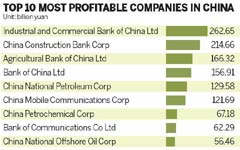
For example, the steep drop in coal prices saw profits for a major coal company fall by 62 percent in 2013. However, the annual salary of the company rose sharply. There are also huge income disparities between financial and nonfinancial companies, and within nonfinancial companies in different industries.
Kuang Xianming, director of the Research Center for Economy at the China Institute for Reform and Development, said the defining characteristic of central SOEs is that their chief responsibility is "public welfare", rather than profit. The central government directly appoints officials as top executives and entrusts them to manage the State assets on behalf of the government. The excess pay often hampers public interest, and most of these officials enjoy dual benefits - from the government and the corporate sector, he said.
"Since most of these officials are by nature trustees, they should be paid on a market basis. But clear accountability should also be established in the trust relationship. Once the value of the State assets significantly shrinks, they should face not only payment cuts but also dismissal," Kuang said.
In response to concerns that talent drain could follow salary cuts in financial SOEs, Kuang said: "Their salaries were higher than those at similar private firms (before the reform). The current measures will ensure that the emoluments return to normal levels. Besides, most people do not choose jobs just for salaries. There are still huge growth opportunities within financial SOEs."
Analysts said more reforms are also needed to put the relations between SOEs and the central government on the right track.
Li Jin, an SOE expert, however, said that it would not be easy for top officials of centrally owned SOEs to become professional managers and that is something that stands in the way of further reforms.

Copyright 1995 - . All rights reserved. The content (including but not limited to text, photo, multimedia information, etc) published in this site belongs to China Daily Information Co (CDIC). Without written authorization from CDIC, such content shall not be republished or used in any form. Note: Browsers with 1024*768 or higher resolution are suggested for this site.
License for publishing multimedia online 0108263 Registration Number: 20100000002731