China is promoting economic transition and innovation to seize the new opportunities and it is willing to work with others in the region
The Asia-Pacific region is experiencing some profound changes, and its economies should be prepared for possible reshaping of economic patterns in an era of slower economic growth.
The region benefited from the first wave of the digital revolution starting in 1990, which caused manufacturing outsourcing and made it possible for low-cost labor in China, India and other Asian countries to participate in the global chain of trade. However, with the second wave of the digital revolution that features smart devices, as well as Europe and the United States trying to revive their manufacturing industries, the market demand for low-cost labor has declined, replaced by a demand for high added-value human capital, which means a primary advantage of these populous nations is gone.
Higher level globalization is another trend. Openness, modern market regulations and innovation are three driving forces propelling various economies to participate in international trade and cooperation more deeply. That's a double-edged sword for developing nations, because it offers hope for prosperity, but implies risks of a financial crisis, even legal and political conflicts.

Together with globalization comes trade protectionism. While propelling the Trans-Pacific Partnership Agreement and Transatlantic Trade and Investment Partnership, the United States and several developed countries have set higher standards for labor rights, and the protection of the environment and intellectual property rights in global trade, which constitute a higher threshold excluding developing economies.
These changes pose challenges to Asia-Pacific economies, but are also opportunities for them to innovate and improve their economic structures. China especially needs to take measures to accommodate these changes. In a speech at the Boao Forum of Asia in April, Premier Li Keqiang said that the Regional Comprehensive Economic Partnership, initiated by the Association of Southeast Asian Nations, would reach agreement in 2015 and become the largest free trade area in Asia; China also holds an open attitude toward the Trans-Pacific Partnership and is pushing another round of reform and opening-up.
China's ongoing reform is also a profound change with lasting influence in the region, even the world.
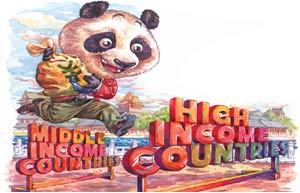
China is joining the club of middle- and high-income economies and its middle-income group is expected to reach 600 million by 2020. As a result, not only domestic consumption and investment, but also exports and outward investment will create new opportunities of growth. Experts predict that China will offer business opportunities worth $17 trillion to the world, as well as 7 million jobs around the world from 2014 to 2020, and its contribution to global economic growth will reach 27 percent.
With economic development, China will further expand its opening-up policy. It is already welcoming waves of globalization in many sectors, and its talent recruitment, capital investment, manufacturing, market, even urbanization process will all be globalized. Some current initiatives, such as the Silk Road Economic Belt, are promoting China's economic integration with neighboring nations.
While manufacturing and low-cost labor used to be China's labels, innovation is playing an increasingly bigger role in its development. In 2013, R&D expenditure exceeded 1.19 trillion yuan ($309 billion) in China, or 2.09 percent of its GDP. With incomes being raised, Chinese consumers are now demanding higher quality products, thus encouraging enterprises to accelerate their R&D efforts; besides, China is strengthening cooperation with the rest of the world on intellectual property rights protection, which grants researchers more freedom.
Having learnt the lessons of the developed countries, which damaged the environment during their development and paid a heavy price in repairing the damage, China is determined to follow a new path of green growth. China promises to cut its carbon emissions per unit of GDP by 40 to 45 percent in 2020, while non-fossil energy should account for 15 percent of primary energy, and forest is expected to expand by 400,000 square kilometers.
All these development fruits will be shared by the whole society and ordinary people. Having invested enormously in improving domestic living conditions, China has vowed to lower the Gini coefficient, a measure of inequality of income or wealth, of its society to below 0.45. Internationally, the new leadership emphasizes more on international cooperation and will help more developing countries to get rich.
To that end, China will continue positively participating in global governance reform and the negotiations for free trade areas. It is striving for tighter economic ties with neighboring countries and regions, which will lay firm basis for Asia-Pacific economic integration.
While doing this, China hopes its goodwill will be echoed by other nations, and we expect the upcoming 2014 APEC Economic Leaders' Meeting this November can make more breakthroughs on economic integration.
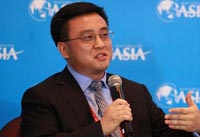
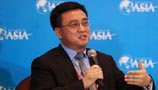
The author is a senior researcher with the National Development and Reform Commission. This is an excerpt of his speech at the recent Pacific Economic Cooperation Council meeting.
 |
 |
|
|
|

Copyright 1995 - . All rights reserved. The content (including but not limited to text, photo, multimedia information, etc) published in this site belongs to China Daily Information Co (CDIC). Without written authorization from CDIC, such content shall not be republished or used in any form. Note: Browsers with 1024*768 or higher resolution are suggested for this site.
License for publishing multimedia online 0108263 Registration Number: 20100000002731