WASHINGTON -- China's economic growth slows but stays healthy, said Olivier Blanchard, chief economist of the International Monetary Fund (IMF).
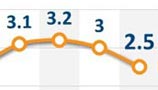
China is expected to grow between 7 percent and 8 percent at current stage. But as it shifts to domestic consumption and services for growth, it could sustain 6 percent growth rate in the longer term, Blanchard told Xinhua as the IMF-World Bank annual meeting is slated to open on Friday.
"Less growth, but better growth for China," Blanchard said.
"It's like a marathon. If you run at 10 percent a year, that may be possible, but you will have problems of pollution, urban tensions and all kinds of other issues," Blanchard said. "Even 6 percent is a good number, much better than many other countries," he added.
China's economy showed deeper signs of slowdown this summer, as a set of economic indicators slipped below their normal level, reigniting the fears of a hard landing of the world's second largest economy.
In its latest World Economic Outlook, the Washington-based lender expected China's economy to grow 7.4 percent this year, and 7.1 percent next year, unchanged from its last forecast in July.
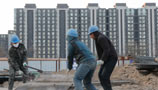
Blanchard said the IMF did not revise the growth forecast for China because it sees the risks of the property sector and shadow banking coming under control.
"The housing prices will come down. We do not think it will become a big financial or fiscal issue. It becomes catastrophic when the decrease of the housing price leads to the bankruptcies of banks, households and the state. That's not the case we currently see in China," he said, citing the relatively low household leverage rate and mortgage rate in China.
He noted that the shadow banking sector poses some problems, but the banks behind the shadow banking system have enough resources if needed. "If there were problems with the banks, the government itself is in a strong position to help," he said.
Despite the downward risks, he underscored that China still has a long way to go in restructuring its economy from too much dependence on investment to consumption led growth, given that investment is still on the rise in China to make up for the loss of momentum of exports.
No easy gains anymore?
The IMF lowered its projection of the global economic outlook to a growth of 3.3 percent this year and 3.8 percent for 2015, as it sees the world still grapples with the legacies of the global financial crisis and the emerging problem of lower potential growth.
Blanchard said the world economy is not expected to be completely back to normal until 2016, at best, as the impacts of the global financial crisis is much bigger than the Great Depression in the 1920s so that it will take a long time to recover.
To boost growth, he said monetary policy is only part of the solution rather than "the magic bullet". Countries should look for ways to shore up the slowing productivity growth.
He also said the global financial sector is in a much better shape after the crisis. The United States increased household saving and pared down the budget deficits, while China also trimmed down its trade surplus. The imbalances between the US and China is not completely gone but largely addressed.
The IMF raised the growth projection for the US economy by 0.5 percentage point to 2.2 percent this year. The United States is among the few leading advanced economies that the IMF foresees a brighter outlook in the World Economic Outlook.
Blanchard said the US economy is in the process of a full-fledged recovery, but the Federal Reserve is still looking at the numbers day by day. "When it feels the US economy has reached the potential output level, they will start increasing the interest rate."
He warned that emerging markets will face tougher global financial conditions when this happens, as capital flows will likely go back to the US from the emerging markets.
"It's going to be tougher for some emerging market countries, but the main issue is the decreasing potential growth. In many countries, the easy gains for growth are getting harder," he said.
|
 |
 |
| China's rebalancing means take effect | Structural reforms more important than growth in China: ADB |

Copyright 1995 - . All rights reserved. The content (including but not limited to text, photo, multimedia information, etc) published in this site belongs to China Daily Information Co (CDIC). Without written authorization from CDIC, such content shall not be republished or used in any form. Note: Browsers with 1024*768 or higher resolution are suggested for this site.
License for publishing multimedia online 0108263 Registration Number: 20100000002731