BEIJING -- The Beijing government has organized a panel discussion for later this month to consider public transport fare hikes that would see the cost of subway tickets more than double.
Twenty-five people, including officials, industrial representatives, legislators, political advisors and members of the public, have been selected for the hearing on October 28, the government announced on Monday.
It is seeking to increase fares for the subway and buses as its subsidization of public transport heaps growing pressure on the budget of the Chinese capital, one of the world's most congested cities.
The government plans to replace the current flat rate with a metered one based on distance traveled. Subway trips under three km will be priced at two yuan (33 cents) and those between three and six km at three yuan, said spokesman Li Sufang at a press conference. Commuters will have to pay more if their trips are longer.
Currently, the city adopts a flat-rate subway fare with unlimited transfers. A single-ride ticket costs two yuan, nowhere near operating costs.
Li said that a single ride will cost an average of 4.3 or 4.4 yuan under the new system.
For commuters paying with a smart card, monthly fare costs after 100 yuan will receive a 20-percent discount, and monthly costs beyond 150 yuan will be discounted 50 percent. Costs beyond 400 yuan per month will not be eligible for discounts.
Li Yuening, who travels more than 18 km from home to work, said she would spend 10 to 12 yuan on commuting every day, and that the increase would be affordable.
Meanwhile, the average bus fare will be raised to 1.3 yuan or 1.5 yuan under the plans, according to Li Sufang.
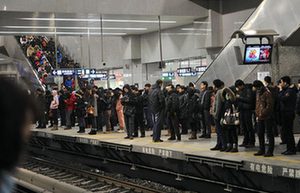
The Beijing municipal government has long subsidized public transport, but the situation has become untenable as the population grows and more pressure is placed on the network.
Even with the fare hikes, the government will still finance 50 percent of subway operating costs and 62 percent of the bus operating costs.
The number of passengers taking subways hit 3.2 billion last year, an increase of 350 percent from 2007. Subsidies jumped from 13.5 billion yuan in 2010 to 20 billion yuan in 2013.
"My biggest concern is whether the volume of passengers can drop along with the fare hike," said a public affairs officer surnamed Liang. To avoid crammed metro trains, she has to leave for the office very early in the morning. She said she expects improved service and fewer passengers after the fare increase.
Some 12.4 percent of respondents to a survey by the Beijing government said they would choose ground transportation rather than the subway after the fare change.
The government estimates that more than 90 percent of metro passengers will spend less than $1 on a single ride after the fare rise and Beijing residents will only need to spend 5.3 percent of their incomes on public transportation on average.
The city has changed the bus and subway ticket prices four times since China's reform and opening up in 1978.
The latest was seven years ago, when Beijing reduced bus tickets to as low as four jiao (6 cents) and two yuan for subway tickets.
 China's top 10 cities for salaries |

Copyright 1995 - . All rights reserved. The content (including but not limited to text, photo, multimedia information, etc) published in this site belongs to China Daily Information Co (CDIC). Without written authorization from CDIC, such content shall not be republished or used in any form. Note: Browsers with 1024*768 or higher resolution are suggested for this site.
License for publishing multimedia online 0108263 Registration Number: 20100000002731