I am in the middle of the Chinese countryside, somewhere between Changsha and Wuhan, traveling north at 300 kilometers per hour on a G-train - the fastest high-speed EMU bullet train in China. The electric multiple unit train has self-propelled carriages.
I don't feel like I'm traveling very fast, because the ride is quite smooth, without the swaying you find on the French high-speed TGV ("Tres Grande Vitesse" or very high speed train), or the Eurostar, which runs at high speed from London to Paris under the English Channel. China's new high-speed train has obviously taken advantage of the massive technological improvements since the 1980s and 1990s, when the TGV and Eurostar were built.
I am sitting in the last carriage, and I walk through the train to the front. There are 15 carriages, making the train almost a half-kilometer long. Ten carriages contain economy class passengers, each with 75 seats. All are full. Three more carriages contain first-class, where I sit. These are nearly full. There's a restaurant car, and one carriage in the middle of the train with the "business class" seats, which you can slide down to a horizontal position for sleeping. Mostly full as well.
There are seats for 999 passengers altogether. Almost all are occupied, and only four passengers on the train are foreigners. Six trains a day, seven days a week, 52 weeks a year - well over a million passengers from south to north every year, and the same the other way, on only one of the high-speed rail routes in China. There are a lot of people moving at high speed across China every day.
We reach Wuhan, and enter another enormous railway station, standing outside the town, with lots of high-speed trains drawn up like horses in their stables, waiting to go somewhere. An attendant brings us our lunch. For 30 yuan ($4.80), you get a plastic tray with lots of rice, plus tofu, peas and carrots, mushrooms - all vegetables. We ask for meat, but it is all gone by the time the attendant reached us, sitting in the final row in the last carriage. Still, it's perfectly edible, and we get a free bottle of water.
The train gets to move and we ease out of the station, gathering speed quickly. Soon we leave Wuhan, and outside the window I can see the Yangtze River underneath the train, as we pass over a long bridge, heading north. We enter one tunnel, then another, and I can feel the train tilt uphill a little. Outside, the flat rice paddies have given way to hills and valleys. We pass through more tunnels. How much did this cost to build, I wonder?
Beside me sits my Chinese wife, Ying. We remind ourselves that the first time we traveled together on board a Chinese train was in 1988, from Beijing to Shanghai, at 60 kph, a 24-hour journey. Today, you can travel by train from Guangzhou to Beijing in eight hours. That's a stunning example of China's development over the past 25 years.
America seems to be able to do fine without high-speed trains, while France, proud of its TGV, doesn't seem to be going anywhere. So should China have spent all those billions of yuan on the biggest high-speed train system in the world? True, they're a convenient way to get from Guangzhou to Beijing in eight hours. It's much easier passing through security in a Chinese railway station than in a Chinese airport. Once in the carriage, the seats are comfortable and you can walk around, and watch one Chinese province after another flash by through the window. I am about to add that trains aren't subject to weather delays, but my wife tells me that the first leg of this May journey, from Shenzhen to Guangzhou, was cancelled because of a mudslide on the track, after the endless torrential rain of the previous fortnight in southern China.
But it's only a little cheaper travelling economy class on a G-train than it is by plane. Is the payoff enough to justify the enormous cost of building the Chinese high-speed network? Is linking Beijing closer with Shijiazhuang, Zhengzhou, Wuhan, Changsha and Guangzhou really that important?
|
 |
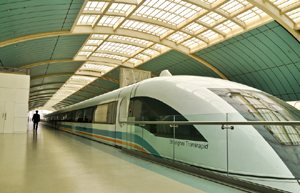 |
| 105-year-old train station bids goodbye | Top 10 high-speed trains in the world |

Copyright 1995 - . All rights reserved. The content (including but not limited to text, photo, multimedia information, etc) published in this site belongs to China Daily Information Co (CDIC). Without written authorization from CDIC, such content shall not be republished or used in any form. Note: Browsers with 1024*768 or higher resolution are suggested for this site.
License for publishing multimedia online 0108263 Registration Number: 20100000002731