BEIJING -- As leaders of 21 Pacific Rim economies met against the picturesque backdrop of a lakeside villa in suburban Beijing, the global impact of China's phenomenal growth over the past three decades remained shrouded in mystery.
 |
 |
In an August newspaper interview, when asked about China's contribution to the world, US President Barack Obama labeled China a "free rider for the last 30 years" that does nothing when "stuff comes up."
However, it now appears that Obama has taken a u-turn and his previous comments on Beijing jar with what he said to business leaders at the APEC CEO Summit on Sunday, when he described China and the US as having "special responsibilities to embrace."
This inconsistency actually reflects a wider anxiety that we have entered a period of "clash of civilizations" that one country's rise might be another's downfall.
But what should a future-oriented Asia Pacific be?
Chinese President Xi Jinping discussed this with APEC economic leaders on Monday, citing an ancient saying: "The top virtue is like that of water, and it benefits creatures yet itself does not scramble." Perhaps the oldest "win-win" philosophy in the world.
Xi's explanation is also supported by the research of Peter Henry, dean of New York University's School of Business. Henry's findings show that in the past 20 years, the mushrooming of emerging economies have not encroached on the growth of the advanced ones. In fact, the latter retained an average of 2 percent growth except in crisis years.
The Chinese "economic miracle" has benefited, is benefiting and will continue to benefit the world.
Xi reaffirmed this during a bilateral meeting with the visiting US president at the Zhongnanhai leadership compound in central Beijing on Tuesday night. Xi said China's stability and development would bring more opportunities to the United States as well as bilateral cooperation.
By Obama's own calculation, over 1.8 million Chinese visitors to America in 2013 contributed $21 billion to the economy to support more than 100,000 American workers.
China's coastal manufacturing hub is home to a large number of Arabian and African traders who make considerable profits, and the shelves of supermarkets worldwide were filled with quality, affordable made-in-China goods. Also, China's urbanization drive has offered unprecedented opportunities for resource-rich APEC economies, for example Russia with oil and gas; Australia with iron; and Chile with copper.
But China is moving away from being a thirsty raw-material importer or merely a windfall for investors.
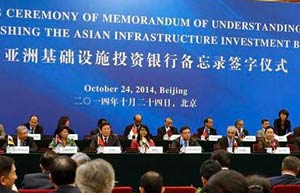
China announced during the APEC Beijing meetings a $40 billion Silk Road fund to improve infrastructure in Asia. Although parallel have been drawn with this program and the Marshall Plan, an American initiative in post-war Europe that poured $17 billion into the rebuilding and bolstering of European economies, it differs in at least three aspects:
Firstly, China is not targeting a bloc or third party, as happened in the Cold War era.
Secondly, China hopes all economies including advanced economies like America and Japan, will fund regional connectivity.
And finally, the granting of low-interest loans plus China's experience of building infrastructure comes without the condescending favor-giving approach.
China knows from its own experience that economic integration can benefit all participants. All APEC economies, including China, demand an open, inclusive and mutually beneficial Asia Pacific market based on good connectivity.
China's success lies in its devotion to a win-win philosophy. Peter Henry wrote in his new book "Turnaround: Third World Lessons for First World Growth", that America should learn from China's sustained commitment to a pragmatic growth strategy.
The world's second largest economy holds no grudges and is open to the sharing of its market, capital and wisdom with its Asia-Pacific partners. The Pacific Ocean is big enough to accommodate more of these so-called free riders.

Copyright 1995 - . All rights reserved. The content (including but not limited to text, photo, multimedia information, etc) published in this site belongs to China Daily Information Co (CDIC). Without written authorization from CDIC, such content shall not be republished or used in any form. Note: Browsers with 1024*768 or higher resolution are suggested for this site.
License for publishing multimedia online 0108263 Registration Number: 130349