Business leaders remain confident in the economic growth in the Asia Pacific region over the next 12 months, according to a recent report by PricewaterhouseCoopers International Ltd.
By surveying 635 CEOs and industry leaders across 39 nations with operations in APEC economies, the report shows that 46 percent of executives are 'very confident' in revenue growth over the next 12 months, up from 36 percent in 2012.
The survey has indicated a loud and clear response from the executives polled: "Be bold and break down barriers to growth. They also added specifics: conclude the Trans-Pacific Partnership (TPP), address intellectual property issues and encourage regulatory harmonization, among other desires," said Dennis Nally, chairman of PwC.
Investments are set to rise across the region. In each of APEC's 21 member economies, there are more respondents who plan to step up investments compared with those who are pulling back. In all, 67 percent say their investments in APEC economies will increase over the next 12 months.
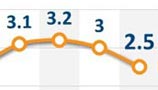
APEC as a whole can expect to see its growth pick up over the next 10 years, from an annual average of 3.2 percent in 2003 to 2013 to 3.5 percent over 2013 to 2023. China's transition towards an ever-larger consumer of finished goods, rather than just a producer, will drive a lot of the transformations expected in the region over the next decade.
"There's no doubt that China is slowing down. But that doesn't meant that it has lost, or is losing its luster, among business leaders," said David Wu, government and regulatory affairs leader in PwC China. "In fact, our survey respondents who already have a presence in China are more confident in the Chinese market for their products and services than they are about the international market."
The growth of the consumer economy is expected to be an important factor in driving Asia's growth, said Jonathan Larsen, global head of retail banking and Asia Pacific head of consumer banking in Citibank, North America. The growth of the middle class, the concentration of wealth, and the concentration of spending and savings power will distinguish Asia's growth momentum from the rest of the world, added Larsen.
Digital power will player a more critical role in the consumer economy as the world's biggest e-commerce market is shifting to Asia, said the report. In China alone, mobile Internet users at the end of June 2014 rose to 527 million, topping access to the Internet by a PC for the first time.
"We've become very close to our smartphones. It's as if they are an extension of our bodies," Pony Ma, chairman and CEO of Tencent Holdings Limited, told PwC.
E-commerce, which today accounts for 4.4 percent of China's GDP, is still in the early stages. Only 20 to 25 percent of small businesses in China have Internet connections, compared to 75 percent in the US, according to research from Oxford Analytica.
"Roughly one billion people from developing countries are now entering the market for the goods and services they see on display in the developed world, setting the stage for a new boom in global e-commerce." David Abney, CEO of the delivery service provider UPS.
Investments are set to rise in each of APEC's 21 member economies with medium-sized companies as the next wave of investors, said the report. The markets are going to be further segmented to give rise to more specialized products and services.
"We've seen very clearly that international trade is gradually changing from a container-based business model to a more fragmented small-order, small-volume business model, which offers the benefits of shorter turnaround time and greater flexibility," said Diane Wang, founder and CEO of DHgate.com, an e-commerce platform that connects business to suppliers in China.
In terms of trade barriers, executives believe that reductions in tariffs help, but businesses are looking for more clarity and consistency in product labeling, data sharing, and local content rules among a host of "non-tariff trade barriers" to their business growth. Despite the proliferation of preferential trade agreements in the region, supply chain managers still think that there is room to reduce customs duty costs.
A majority of executives still see momentum towards APEC's long-time goal of a Free Trade Area of the Asia Pacific (FTAAP). But most also believe that progress has slowed over the past year and urgently needs a breakthrough.
The report suggests that policymakers and business leaders should realize that the faster barriers can be lowered, the faster these economies can grow. "Soft" barriers around customs rules or in sharing data across borders create additional costs that make Asia's economies less competitive.
 |
 |
| FTAAP a common vision, not a new rival |
|

Copyright 1995 - . All rights reserved. The content (including but not limited to text, photo, multimedia information, etc) published in this site belongs to China Daily Information Co (CDIC). Without written authorization from CDIC, such content shall not be republished or used in any form. Note: Browsers with 1024*768 or higher resolution are suggested for this site.
License for publishing multimedia online 0108263 Registration Number: 130349