 |
|
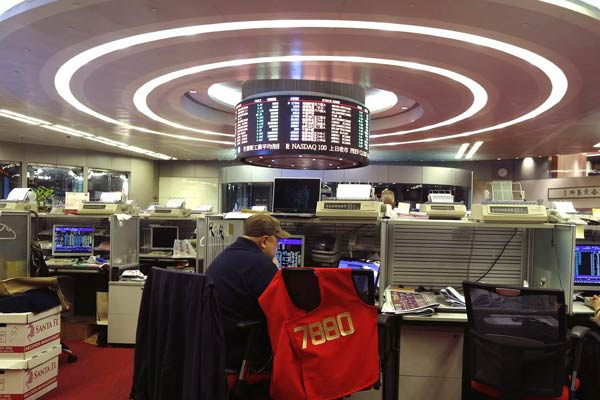
A floor trader monitors share prices during morning trading at the Hong Kong Stock Exchange in Hong Kong November 17, 2014. [Photo/Agencies] |
The Shanghai-Hong Kong Stock Connect program met a lukewarm response from investors, especially mainland investors, if statistics are considered.
The program sets daily investment quotas for investors. On Nov 17, when the program made its debut, Hong Kong investors used up the daily quota to invest in the Shanghai market, but mainland investors only used 16.8 percent of their quota to invest in Hong Kong stocks. The trading enthusiasm continued to fade in the next two days. On Nov 18, Hong Kong investors used 37 percent of the quota while their mainland spent only 8 percent. The following day, both percentages touched new lows. Hong Kong investment ratio came to 20.1 percent, but still proudly belittled mainland investors' meager 2.4 percent.
These ratios clearly show that Hong Kong investors' interest in the mainland market is much greater than the other way.
The difference was caused by several reasons.
First, the program itself sets different thresholds and scopes between Hong Kong and mainland stock investors.
For Hong Kong investors, there is no minimum cash requirement, but mainland investors are required to have at least 500,000 yuan in their investment accounts. This means that only high-net-income mainland investors are allowed to trade Hong Kong stocks.
The number of choices is another reason. Hong Kong investors face much more choices of stocks. They are allowed to invest in 568 Shanghai stocks but mainland investors only have 268 Hong Kong stocks to choose from. More choices can definitely prompt greater interest for investors.
Second, Hong Kong market has been open for global investors for decades. Even before the stock connect program was initiated, mainland investors, especially those in the Pearl River Delta, may have already invested in Hong Kong, taking advantage of the openness of Hong Kong. What they need to do is simply opening a stock account when they tour Hong Kong. But the chance for individual Hong Kong investors to trade Shanghai stocks is limited, as A-share market was strictly closed for individual overseas investors. The stock connect program is the first time for retail investors from overseas to directly trade A shares. This feeling of freshness lured many Hong Kong investors.
Third, the investment sentiments are different between Hong Kong and the mainland. Hong Kong is a international financial center, with the financial industry a pillar of the city. Local residents remain keen stock traders despite ups and downs of the stock market. By comparison, mainlanders' investment sentiment is strongly associated with the market performance. Their enthusiasm of stock trade rose to an all-time high in 2008 amid a bullish market. Since then, the fever faded quickly with the downturn of the market, and has not recovered up to now. This explains why mainland investors' interest in the stock connect program is weaker than their Hong Kong counterparts.
Last, information publicity and investor education lead to difference between Hong Kong and mainland investors. In Hong Kong, financial information spreads more efficiently as local investors are finance savvy and the city itself is not big. But on the mainland, investor education and information publicity may be harder to push due to the big market size and the lower level of general investment knowledge among investors. According to a survey by China Securities Regulatory Commission, 68.1 percent of mainland investors said they were not familiar with investment rules of the stock connect program, and 67.3 percent said they didn't know much about the Hong Kong market. So, there is no wonder mainlanders are not very keen to invest in Hong Kong for now.
The author is a Shanghai-based financial analyst.

Copyright 1995 - . All rights reserved. The content (including but not limited to text, photo, multimedia information, etc) published in this site belongs to China Daily Information Co (CDIC). Without written authorization from CDIC, such content shall not be republished or used in any form. Note: Browsers with 1024*768 or higher resolution are suggested for this site.
License for publishing multimedia online 0108263 Registration Number: 130349