 |
|
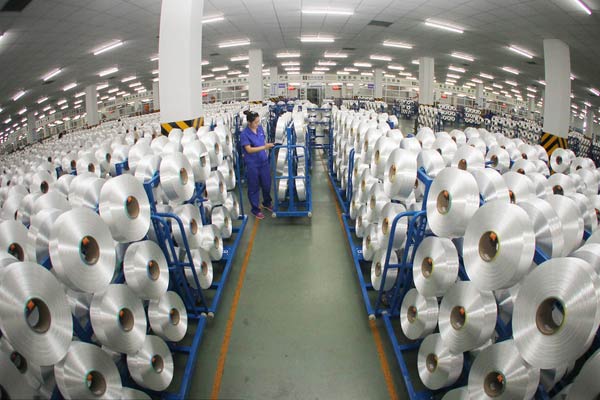
A worker conducting routine checks at a spinning workshop of Hengli Group in Nantong, Jiangsu province. [Provided to China Daily] |
Relocation to Africa, in terms of costs and market access is proving attractive for companies
With the average wage of the 23 million textile workers in China reaching $600 a month, garment factory owners are starting to greet each other with a variation of: "Have you moved the factory out of China yet?"As a labor-intensive industry, garmentmaking faces great pressure as labor costs soar in China.
Wang Tiankai, director of the China National Textile and Apparel Council, says the minimum wage is growing 10 percent a year. "And by only offering the minimum wage, you can never recruit a skilled worker," Wang says.
Labor costs are not the only challenge: Figures from the council show the momentum of China's textile industry has slowed significantly since 2011. From 2000 to 2010, average growth was 18.8 percent, but that dropped to 12 percent over the past four years.
The price of high-quality cotton in China is about 30 percent higher than the international level, which caused fiber processing in China to drop by 26 percent last year, the council says.
Major garment makers are reacting differently to these challenges. Two main paths have emerged: moving to Africa or Southeast Asia for the low-cost labor, or staying in China to make premium products.
Yuemei Group belongs to the first group. Established in Zhuji, Zhejiang province, in 1992, Yuemei has a presence in seven African countries including Nigeria, Ghana and Tanzania, and has hired 2,600 African workers.
Xu Zhiming, chairman of Yuemei Group, now operates 40 percent of his business in Africa and the rest in China. He says the situation will be reversed in three to five years. The company's current annual output in Africa is worth $30 million.
"Africa will definitely be the manufacturing center of the world in the future," Xu says.
This year the company bought a cotton plantation in Mali that will soon supply raw material for its cloth-making operations in Africa. Once the mill reaches full capacity, it will cut the cost of raw materials by 50 percent, Xu says.
Chinese textile companies' investments are welcome in African countries. Morocco, for one, is avidly seeking Chinese capital and know-how.
Under Morocco's 2009 industrial development plan, it would attract foreign investment to help develop six major industries, and textile is high on the agenda.
The Moroccan Investment Development Agency says most garments made in Morocco are exported to Europe or the United States and bring in revenue of about 4 billion euros ($4.95 billion) every year. Most of the products are fast-fashion or ready-towear garments. The agency is a government body that helps attract foreign investment to Morocco. Fast fashions are those that move from the catwalk to retailers quickly to capture the latest trends.
Mohamed Tazi, director of the Moroccan Association of Textile and Apparel Industries, says Chinese garment producers can look to gain better access to European, African and other markets if they set up factories in Morocco. They can take advantage of the country's strategic position at the crossroads of the main trade routes linking Africa and Europe, as well as its free trade agreements with the United States, the EU, Turkey, Jordan, Tunisia and West Africa.
"Morocco is an ideal platform for Chinese clothing and textile producers to access markets with more than 1 billion consumers," says Tazi, adding that the textile industry contributes more than 13 percent of Morocco's GDP.
Chinese entrepreneurs would also help Morocco complete the local supply chain, Tazi says.
"We are looking for Chinese partners who can bring in designs, fabrics, production, and accessories that will enable us to make faster deliveries. We are not looking for partners who just bring in money, but partners who are willing to work with us to realize common goals.
"The opportunities here are tremendous. Companies can even make money by just providing training services for garment manufacturing." Some garment companies from Hong Kong have already moved their factories to Morocco, he says.
Somitex Morocco, which supplies fast fashion clothes to UK retailers such as Marks&Spencer, Sainsbury's and Monsoon, is the biggest garment manufacturing company in Sale, a city in northwestern Morocco. It wants to work with a Chinese company to produce more accessories and expand its capacity.
"We have to import lace from the Middle East and Asia since the same is not produced locally. The long time it takes to ship the goods from China has led to delayed shipments from our side," says Abdelhai Bessa, chairman of Somitex.
"If Chinese companies can set up fabrics and accessories factories in Morocco, it will be easier for us to procure the required products locally. It gives us more flexibility and enables us to be more responsive to consumer demand."

Copyright 1995 - . All rights reserved. The content (including but not limited to text, photo, multimedia information, etc) published in this site belongs to China Daily Information Co (CDIC). Without written authorization from CDIC, such content shall not be republished or used in any form. Note: Browsers with 1024*768 or higher resolution are suggested for this site.
License for publishing multimedia online 0108263 Registration Number: 130349