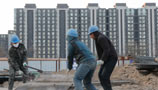
HAIKOU -- In Lingshui, an autonomous ethnic minority town on South China's Hainan Island, the real estate sector has driven growth for the past decade. But the industry's magic seems to have run out this year.
Total housing area sold and sales volume plummeted by 14.7 percent and 7.4 percent respectively in the first three quarters of this year, leaving local government to review its economic development policies.
"We did feel the changes in the market and the whole economy, so called the 'new normal,' and we know that to survive and thrive, we must change our way of economic development and find new growth engines," said Yang Wenping, head of the local government.
The town has sought cooperation with other countries such as Singapore and Israel and international companies like Microsoft to bring in advanced technology and investment by setting up an agriculture R&D base and IT industrial parks.
The small town's efforts to adjust to the economic "new normal" have opened opportunities to the rest of the world, echoing the insights of a key CPC economic meeting that concluded this week. At the meeting, Chinese leaders mapped out major economic policies and priorities for the coming year, which are expected to benefit not only China, but the entire world.
From "Made in China" to "Made for China"
According to the conference, China will adjust inbound and outbound trade and investment patterns to achieve balance of international payments. It will also expand market access in the service sector, open up the manufacturing sector more, and promote the China (Shanghai) Pilot Free Trade Zone (FTZ) model.
By 2020, China's middle class population is expected to reach 600 million, the country's import volume could surpass $17 trillion and outbound direct investment is expected to top $1.2 trillion. That means 7 million new jobs and 27 percent of the world's GDP growth, according to Zhang Yansheng, secretary general of the academic committee at the National Development and Reform Commission, the top economic planner.
"With rising income, Chinese consumers now have a bigger and more diverse appetite for global high-quality products, and the country's previous export and import policies are expected to be adjusted accordingly," Zhang added.
"That means a transition from 'Made in China' to 'Made for China.' The demand for safer food, brand-name cars, financial products and overseas travel is likely to grow impressively both in speed and volume," said Goldman Sachs economist Ha Jiming.
Going global
The country, under pressure to upgrade its industries and restructure its economy, has increasingly been eyeing the overseas market for a way out. The firms attached to China's last three decades of growth will be looking to diversify into new markets.
China's outbound direct investment (ODI) is expected to outpace foreign direct investment (FDI) for the first time ever this year. Nearly 5,000 Chinese firms invested in 154 countries and regions in the first ten months of this year, with ODI by non-financial firms up 17.8 percent year on year to $81.9 billion. Meanwhile, FDI on the Chinese mainland dropped 1.2 percent year on year to $95.9 billion, according to the commerce ministry.
Chinese enterprises that venture overseas now have more diversified portfolios, expanding from traditional natural resources to technology and brands, and China's efforts to facilitate innovation and urbanization and develop a modern service sector need international experience and cooperation, said Merit E. Janow, Dean of Columbia University's School of International and Public Affairs.
Open world economy
China is also promoting an open world economy by building cohesive regional trade networks and enhancing regional connections such as the "21st Century Maritime Silk Road" and the "Silk Road Economic Belt."
Regional economic cooperation platforms like the Asian Infrastructure Investment Bank, the BRICS Development Bank, the Silk Road Fund and the Euro-Asia High-Speed Transport Corridor will boost regional inter-connectivity and finance regional cooperation.
China has signed 12 free trade agreements, lowering trade barriers in 20 countries and districts for Chinese business. China has also wrapped up free trade agreement negotiations with South Korea and Australia.
"China's efforts to embrace the 'new normal' not only mean a more balanced domestic growth model, but also may contribute to a more open and efficient regional and global development framework," Zhang said.

Copyright 1995 - . All rights reserved. The content (including but not limited to text, photo, multimedia information, etc) published in this site belongs to China Daily Information Co (CDIC). Without written authorization from CDIC, such content shall not be republished or used in any form. Note: Browsers with 1024*768 or higher resolution are suggested for this site.
License for publishing multimedia online 0108263 Registration Number: 130349