 |
|
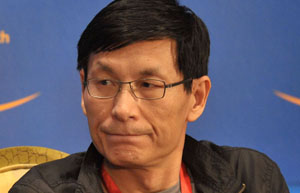
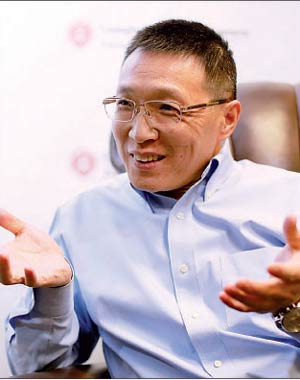
Zhang Zhixue, professor of management at Guanghua School of Management at Peking University. PHOTO BY FENG YONGBIN/CHINA DAILY |
Is China now at the vanguard of a management revolution?
Theories about how business organizations are managed over the past century have largely been of American or European origin.
The founding father of the new science of management was the American Frederick Winslow Taylor. His Principles of Scientific Management about making factories more efficient came at a time when Model-T Fords were rolling off the production line just before World War I.
Other giants in the field have been Frenchman Henry Fayol and his general theory of management; German sociologist Max Weber, who apart from writing about Chinese religions, was also interested in bureaucratic systems; and Peter Drucker, the leading modern thinker who came up with management by objectives in the 1950s.
This Western orthodoxy has only been challenged before by Japan. Just in Time was pioneered by Toyota in the 1950s and was about keeping stock levels for the production line at a minimum to reduce costs.
Total Quality Control was another concept about delivering long-term customer satisfaction that was attributed to Japanese organizational theorist Kaoru Ishikawa in the 1980s.
Now, management theory and practice is facing another assault from the East, according to leading management theorists.
Peter Williamson, professor of international management at Judge Business School at Cambridge University and who has years of experience working in China, co-authored an article with his colleague Eden Yin, Accelerated Innovation: The New Challenge from China? in the MIT Sloan Management Review earlier this year.
The article argues the Chinese have developed a new system of management using their huge reservoir of scientists and technicians to reduce some product development cycles from 10-15 years to just one to two years with enormous repercussions for industry.
Another article, A Chinese Approach to Management, in the Harvard Business Review by Thomas Hout at the Monterey Institute of International Studies and by David Michael of Boston Consulting (who himself spent a number of years in China) explores how Chinese managers have come up with a system to deal with perhaps the fastest moving consumer market in the world.
Both raise questions of whether Chinese companies are inventing radical new methods of business organization, which will not just be applicable to China in the future but will become universal concepts.
Certainly, a number of Chinese companies, including Alibaba, the Chinese e-commerce giant founded by Jack Ma and which had the largest IPO in history on the New York Stock Exchange earlier this year; Tencent, a Chinese company that operates the WeChat instant messaging service; and Haier, the electrical goods maker inspired by its chairman Zhang Ruimin, have been hotbeds of new ideas.
One who believes that management consultancies, in particular, need to pay more attention to what is happening in China is Edward Tse.
The former chairman of Booz & Co Greater China and author of the influential book The China Strategy, set up his own China-based management consultancy Gao Feng Advisory earlier this year.
Tse believes management theory has been in some form of time warp since the 1980s and is in need of an injection of new ideas. "This is the paradox of the whole thing. In business schools in the US and around the world everyone is talking about the same sort of issues, the same sort of intellectual capital as they were 30 years ago," he says.
"The starting point is always (Harvard academic) Michael Porter's competitive strategy or core competence theory developed in the 1990s (by US academics C.K. Prahalad and Gary Hamel) and until now there hasn't been much progress."
Tse, who was speaking in a Starbucks at Liangmaqiao in Beijing among students who might easily be among the next generation of Chinese managers, believes the fast-moving developments in China will soon lead to a new management theory.
"It is a matter of codifying this new evidence into a management theory. Neither what has happened in China over the past five or 10 years nor, indeed, in Silicon Valley with the emergence of Facebook and Amazon has resulted in that but I think it will happen. What we have in China is a speed and intensity of change that is becoming something of a phenomenon."
Zhang Zhixue, professor of management at Guanghua School of Management at Peking University and one of China's top management schools, however, believes the classical management theories still hold and are still as applicable in China as elsewhere.
"I don't actually see any new theories coming from China that go beyond the mainstream theories from Europe and the United States," he says.
"When we talk about classical management theory we are still talking about Taylor's scientific management and the theories of (Henry) Fayol and Max Weber from Germany. They are still mainstream."

Copyright 1995 - . All rights reserved. The content (including but not limited to text, photo, multimedia information, etc) published in this site belongs to China Daily Information Co (CDIC). Without written authorization from CDIC, such content shall not be republished or used in any form. Note: Browsers with 1024*768 or higher resolution are suggested for this site.
License for publishing multimedia online 0108263 Registration Number: 130349