Investment banks have released quite a few reports on China in 2015. Some points are obvious.
One of the easiest things in the world to forecast is Beijing's further lifting of the overall credit line, including a few cuts in the interest rate and banks' reserve requirement ratio, most likely between the first and second quarters.
Government-led growth stimulus, mostly jointly underwritten by the central coffer and large financial and corporate entities, will be huge. To some extent, it can be called quantitative easing with Chinese characteristics, although the use of funds will be targeted more to mega national public infrastructure in the interior and western frontier regions.
Investors in the domestic A-share market are already crazy about shares of companies likely to sell products or services to national investment projects.
However, not many have noticed a conspicuous absence, namely the lack of local governments' role in the national projects. At the very least, a high-speed railway needs to be connected with meaningful local projects, such as those in tourism, to realize the potential benefit it can bring.
Despite the up-and-coming opportunities, local governments are in unprecedentedly poor financial shape.
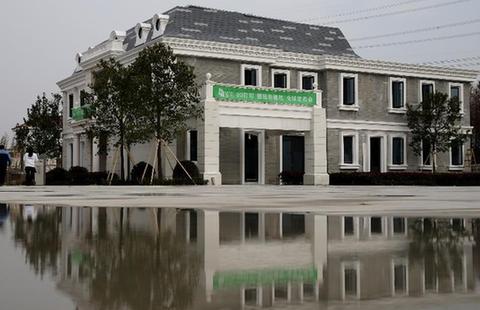
They have already spent all of their money in their reckless housing investment cycle a few years ago. Many of them are deep in debt, so much so that a casual survey of the large empty towns they built can speak of their virtual recession. Some analysts have warned that some second- and third-tier cities may suffer double-digit negative growth this year.
The financial state of perhaps half of Chinese cities is, interestingly enough, similar to the lives of the corrupt officials who cannot continue to use public funds but cannot even offer to resign from their posts, either. They have to remain where they are and wait for the central discipline officers to take them away for investigation.
Those "problem cities" cannot continue to borrow-because banks don't want to lend to them for their local government financial vehicles.
They cannot issue local development bonds-firstly because none of China's provincial-level governments has ever tried to do so, and secondly those cities' credit rating levels would be risky because of their existing debt levels. They can't find an easy solution to their debt problem.
Of course, one has to point out that China's governmental fiscal crisis in 2015 will primarily be one occurring on the local level and is unlikely to harm the central government. Some provincial governments have also announced that they are not going to protect the irresponsible cities and counties in their territories if they should go bankrupt. China's financial system is unlikely to encounter major problems.
Yet the differentiated city-level debt situation will inevitably result in increasing polarization in local economies. And more importantly, that polarization process will continue for years to come.
In 2015, some cities, mostly those with a diverse business base in coastal areas, will strike forward and register close to 10 percent, if not higher, local GDP growth.
In the meantime, the few star cities in central and western China, such as Chongqing, Chengdu and Xi'an, will continue to be all right thanks to their own economic potential and support from the central government.
But cities that are based on one or just a few old industries, such as mining and steel-making, are going to face greater problems than in 2014. They cannot get the capital to transform the local economy, and their local GDP growth will lag behind the national average by a wide margin. The problem was already spotted in some resource-rich provinces. It will become a trend in 2015, representing the necessary cost that China will have to pay for its overall change.
It takes more than just a couple of years, certainly longer than some officials hope for, for a nation to go through an economic transition. It is still early to tell which cities will be champions, or what kinds of winners they will be. But 2015 will decide which cities will be the losers.
The author is editor-at-large of China Daily.

Copyright 1995 - . All rights reserved. The content (including but not limited to text, photo, multimedia information, etc) published in this site belongs to China Daily Information Co (CDIC). Without written authorization from CDIC, such content shall not be republished or used in any form. Note: Browsers with 1024*768 or higher resolution are suggested for this site.
License for publishing multimedia online 0108263 Registration Number: 130349