 |
|
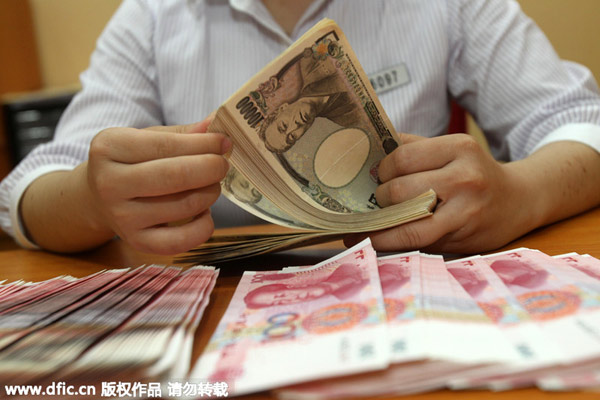
A clerk counts the banknotes of Japanese yen in Nantong city, East China's Jiangsu province, June 14, 2012. [Photo/IC] |
Chinese regulators are turning to Japan for lessons on economic history, determined to keep the world's second-biggest economy from taking the same path of recession and deflation that has blighted its neighbor for the past 20 years.
China views Japan's handling of the liberalization of capital flows and the yen more than 30 years ago as key factors that led to the creation and subsequent bust of the asset bubble in the island nation in the early 1990s, according to Japanese government and other sources who are in direct contact with Chinese regulators.
"They aren't a single bit interested in Japan's successes. Their biggest interest is in Japan's mistakes," one Chinabased source who is directly in touch with Chinese regulators told media on condition of anonymity.
"Japanese and Chinese economies do share many similarities, so I assume there is quite a lot to learn from our experiences."
Chinese policymakers and analysts at government thinktanks are already well versed in the experiences of Japan and other countries, and the sources say two-way communication at both government and private-sector levels continued even through a chill in diplomatic ties after a territorial spat in 2012.
But as economic growth slows and signs of deflation emerge, China's interest in Japan has increased notably around policy details, according to the sources.
At the annual meeting of the National People's Congress, the top legislature, that began on March 5, China announced an economic growth target of around 7 percent for this year, down from 7.4 percent in 2014, already the slowest in 24 years.
Lost decades
China is carrying out three key financial reforms Japan undertook over the past decades-liberalizing interest rates, internationalizing its currency and opening up its capital account.
These reforms should help develop the economy, but missteps could have huge repercussions.
Chinese policymakers see the 1985 Plaza Accord between Japan and the Western powers, which effectively approved a stronger yen and the opening up of the capital account during the 1980s and 1990s, as pivotal events for Tokyo which ultimately led to Japan's "lost two decades", sources say.
The surge in the yen that followed the agreement hit the country's main exports; Japanese auto makers, for example, started shifting more production overseas. This started to hamper economic growth and prompted the Bank of Japan to ease monetary policy.
However, much of the cash from the easing, along with hot foreign money that followed the liberalization of the capital account, flowed into stocks, property and other assets, often magnified through leveraging.
"China is already applying lessons from Japan's experience. Even when growth is slowing, Chinese policymakers aren't taking policy measures that could heighten financial imbalances. That's very wise of them," Bank of Japan board member Takahide Kiuchi told a news conference in Maebashi, north of Tokyo.
He said that even when asset bubbles were forming, Japan wasn't able to tighten monetary policy because of the impacts it would have on the United States, its biggest partner.
"One of the lessons from Japan's experience is that achieving domestic economic stability should be the top priority for policymakers (rather than international considerations)," Kiuchi added.
China has other challenges that echo Japan's past.
Its property market has cooled since the government tightened policy to prevent overheating and due to oversupply, and that, coupled with economic slowdown, is raising fears of a rapid rise in bad loans at banks and a further dent in local government finances.
"It makes perfect sense for them to look to Japan rather than other countries since our financial systems are very similar," said another Shanghai-based source.

Copyright 1995 - . All rights reserved. The content (including but not limited to text, photo, multimedia information, etc) published in this site belongs to China Daily Information Co (CDIC). Without written authorization from CDIC, such content shall not be republished or used in any form. Note: Browsers with 1024*768 or higher resolution are suggested for this site.
License for publishing multimedia online 0108263 Registration Number: 130349