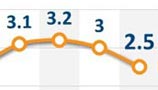
As a visiting professor in Beijing, I recently spent an evening talking about China's economic development with a group of futures traders at a short executive education course. One thing we all agreed on was that a shrinking workforce and an unbalanced economy are serious obstacles to the chances of China overcoming the middle-income trap that has caught so many promising emerging countries.
How can China create enough value to raise the living standards of its huge population, not perhaps to the standards of the United States, but at least to an average annual income of $20,000?
The answer can only be found in the thoughts of a Scotsman who died more than 200 years ago. Adam Smith's greatness was that he showed us how society, if left to itself and properly regulated via the rule of law, will find the most efficient and productive way to create wealth for its members.
The secret lies in the division of labor, in specialization, in competition, and in the application of new processes and technologies by individuals trading with each other who wish only to benefit themselves and their families.
In Smith's analysis, "enlightened self-interest" produces prosperity. He commented that a country with a free, competitive market, which trades widely with other countries, does not need a stock of gold, because it can create the wealth to acquire gold, or anything else it requires.
The truth of Smith's analysis can easily be seen by comparing relatively poor countries that are rich in resources-for example, Zimbabwe and Russia-with countries such as Switzerland and Singapore that are rich but lack natural resources.
On their own, natural resources, which run out and can be grabbed by powerful elites, do not make a country wealthy. National wealth depends on a competitive, market-driven system, operating within a clear and fair framework of rules and regulations that encourage individuals to trade with each other, with the sole purpose not of trying to help each other, but of improving their own situation.
Nicholas Lardy, of the Washington-based Brookings Institution, is one of the world's leading foreign analysts on the Chinese economy. His 2014 book, Markets Over Mao, demonstrates that China's small and medium-sized enterprises have driven growth in employment and GDP since the 1990s.
But for many inside China, Lardy's thesis is not convincing. Most bureaucrats and policymakers believe that the State-owned enterprise is more important to China than the private entrepreneur. For them, Adam Smith is not relevant to China's situation.
However, one of China's most important economic thinkers is a disciple of Smith and a firm believer in the free market. His ideas have become well-known in China and underpin the government's new economic direction.
His name is Zhang Weiying.

Copyright 1995 - . All rights reserved. The content (including but not limited to text, photo, multimedia information, etc) published in this site belongs to China Daily Information Co (CDIC). Without written authorization from CDIC, such content shall not be republished or used in any form. Note: Browsers with 1024*768 or higher resolution are suggested for this site.
License for publishing multimedia online 0108263 Registration Number: 130349