Slower growth and loss of market share dampened China's coal demand in 2014, according to a prominent industry review.
The annual statistical review of world energy, which has just been released by Britain-based energy giant BP Plc, indicated that China's coal output decreased 2.6 percent last year, the weakest performance since 1998.
Globally, coal production fell by 0.7 percent in 2014, with China registering the largest decline, according to the review.
The decreased output of coal led to overall lower energy production in China, which increased only by 0.2 percent in 2014, according to the review.
According to the review, global primary energy consumption increased just 0.9 percent in 2014, its slowest rate of growth since the late 1990s.
"The slowing was driven in part by the rebalancing of the Chinese economy away from energy-intensive sectors causing the growth of energy consumption in China to slow to its lowest rate since 1998," said Spencer Dale, BP's group chief economist.
Even so, China remained the world's largest growth market for energy, he said.
"The slowing pace of China's industrialization also caused the growth in the country's coal consumption to stall and the global coal consumption growth to be unusually weak," Dale said.
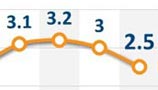
The changing pattern of the economic development caused the growth of China's energy consumption to slow sharply to just 2.6 percent in 2014, less than its average growth over the past 10 years, which was 6.6 percent, according to the review.
Although the growth rate was the weakest since 1998, that does not signal a new trend, Dale said.
"It is expected to see the rate of decline in China's energy intensity to taper off gradually as it converges to the levels of more developed economies," said Dale.
Energy intensity measures how much energy is required to generate a unit of GDP.
"The exceptionally low levels of growth reached in the energy-thirsty sectors, including iron, steel and cement, are perhaps unlikely to be sustained, pointing to the possibility of some bounce-back in energy demand in the near future."
Dale called for more use of clean energy to improve energy efficiency as China could still require more consumption of energy to support its economic growth.
"Clean energy will help boost the adjustment of Chinese economy," he said.
Coal has lost share in the power sector in China, in part because of exceptionally strong growth in hydropower, as new capacity came on stream and high levels of rainfall buoyed utilization rates, according to Dale.
In Guangdong province, an economic powerhouse in South China, more clean energy such as nuclear power and hydropower would be promoted in the years ahead as the province has been making efforts to transform itself from an industrial base to a more service-oriented economy, said Zeng Lemin, director of the Guangdong Technology and Economic Development Research Center.
"We will reduce the use of coal in industry. Instead, promotion of clean energy including wind power, nuclear power and hydropower will support the province's economic transformation," Zeng said.

Copyright 1995 - . All rights reserved. The content (including but not limited to text, photo, multimedia information, etc) published in this site belongs to China Daily Information Co (CDIC). Without written authorization from CDIC, such content shall not be republished or used in any form. Note: Browsers with 1024*768 or higher resolution are suggested for this site.
License for publishing multimedia online 0108263 Registration Number: 130349