Regional integration will create demand for Chinese capital and consumer goods
China's Belt and Road Initiative envisages greater economic trade between China and Asia, Africa, Europe and the Middle East. It will also benefit firms in China's overcapacity industries, which will lead to diversification as well as encouraging greater globalization of the yuan.
At the same time, the strategy will face various geopolitical and project financing risks.
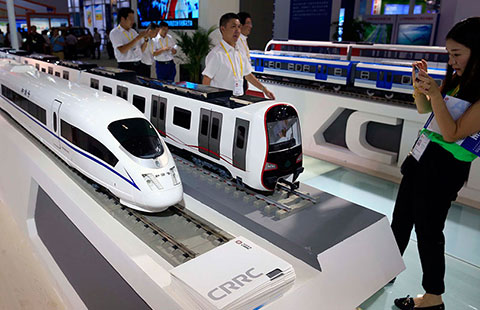
The measures proposed as part of Belt and Road Initiative aim to improve intra-regional commercial and financial links through substantial investments in infrastructure projects. These will include railways crossing the Eurasian landmass and enhanced port facilities around the Indian Ocean.
We expect that deeper regional integration will create long-term demand for Chinese capital and consumer goods, as well as services. Meanwhile, demand which materializes now will support Chinese exports at a time when traditional markets - such as the eurozone and the United States - continue to post historically low economic growth rates.
As such, the initiative will have a positive influence on Chinese corporations. Companies operating in industries such as steel, building materials, maritime transportation, power and construction will benefit the most.
The plan will also help companies that use natural resources, such as oil and gas, or agricultural players, and railway firms. China will gain from greater diversification in its energy imports, as supplies from Russia and Central Asia are developed as alternatives to traditional sources in the Middle East and North Africa.
We also expect Chinese financial institutions, with regional experience in financing, to benefit from the initiative. They will gain wider market access with increased demand for loans, although at the expense of taking on higher risk.
The provision of regional investment and lending will encourage greater international use of the yuan, which is one of the government's stated economic objectives en route to capital account liberalization.
Nonetheless, the Belt and Road Initiative will not directly lead to a greater opening-up of China's capital account, because official statements have not made a direct link between the two policies.
The plan also provides impetus to address provincial imbalances by channeling investment into China's inland and western provinces. They are comparatively less developed than provinces on the eastern seaboard. This will come off the back of transnational networks and stronger links with Europe and the Middle East.
Finally, China's international assets are heavily skewed toward liquid, low credit risk but also low-yielding reserve assets such as US Treasuries. There is ample scope for China's international investments portfolio to assume greater risk in line with its peers. And the funding for the initiative will provide a vehicle for China to switch some of its international assets into higher-yielding infrastructure investments.
Nonetheless, one consequence is that the Chinese government will also increase its exposure to many countries with weak credit profiles, such as unrated or sub-investment-grade emerging markets. We believe that such risks will be manageable within the context of the overall size of China's international asset portfolio.
Despite these benefits, the intra-regional plan also faces a number of major challenges. It is unlikely to provide an ultimate solution to an oversupply in industrial sectors in China.
There is also a risk that some regional and local governments may use the initiative as motivation to continue their ambitious infrastructure investment programs, notwithstanding the central government's policy goals of stabilizing regional finances. Beyond these issues, we see two broader challenges to the implementation of the Belt and Road Initiative: geopolitical factors and project financing risks.
Geopolitical risk factors may make it difficult for China to realize its ambitions of an integrated intra-regional transport network. Existing regional and territorial disputes, such as prevailing tensions in the South China Sea, could dissuade several countries, particularly those not in need of major financing, from participating in the projects.
Political risk factors exist even for countries with traditionally close ties to China, because a change in administration may result in China-financed projects being revisited or renegotiated.
Secondly, committed capital to Belt and Road-related infrastructure stands at $140 billion, mainly in the form of the Silk Road Fund and Asian Infrastructure Investment Bank. However, although representing an important new source of funding, the institutions will be able to make only a modest contribution to filling Asia's multi-trillion dollar infrastructure gap during the coming decade.
As such, further State funding as well investment from banks and corporates will be required to realize the ambitious aims of the intra-regional strategy.
Michael Taylor is managing director for Moody's Investors Service and the company's chief credit officer for Asia Pacific; Rahul Ghosh is Moody's vice-president and senior research analyst.

Copyright 1995 - . All rights reserved. The content (including but not limited to text, photo, multimedia information, etc) published in this site belongs to China Daily Information Co (CDIC). Without written authorization from CDIC, such content shall not be republished or used in any form. Note: Browsers with 1024*768 or higher resolution are suggested for this site.
License for publishing multimedia online 0108263 Registration Number: 130349