Some time ago, the term "Made in China" seemed to be out of fashion. Some in the academic circle, as well as policymakers, were calling to replace the term with "Invented in China".
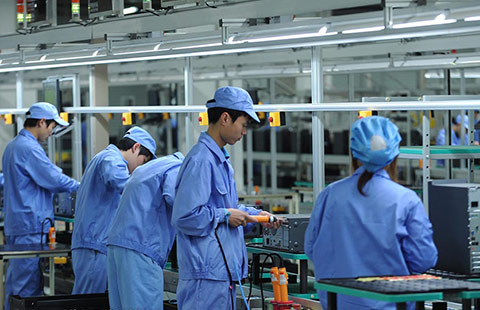
I often wonder what's actually wrong with Made in China, as China is the manufacturing center of world. So, for me, the State Council's recent policy circular on the "Made in China 2025" is a big relief.
It's an important document outlining the development direction for China's manufacturing industry during the next 10 years and beyond, and dispels doubt over the future of the industry. Made in China will live on for many years to come.
To understand the significance of that document, we had better take a retrospective view on the evolution of China's manufacturing industry in the recent past. China's current status as the center of global manufacturing did not come easy. It has gone through several stages.
In the early years of economic reform and opening-up, China's almost unlimited supply of unskilled labor, with little exposure to market competition, made China the fertile land of process manufacturing and trade, and an ideal location for outsourcing by multinational enterprises from industrialized nations.
I consider the first 24 years of China's economic reform as the first stage of Made in China. That period was characterized by a combination of international capital and technology flow, and China's abundant labor supply. Throughout that period, a large number of entrepreneurs and workers learned the skills of modern manufacturing in a market environment, and ways to conduct business. As a result, that created numerous large, indigenous companies looking for markets.
The growth of these companies accelerated and they were eventually tested in the global market when China joined the World Trade Organization in 2001, which is when Made in China entered phase two.
With China fully integrating into the global economy, the country's comparative advantage of abundant labor resources was fully utilized and highlighted the international competitiveness of China's manufacturers. In the subsequent 15 years, the country became the world's factory.
During that process, China built up a large pool of skilled workers to support its manufacturing industry. The nation also developed its extensive infrastructure and logistic systems over a short period of time. Although China runs a deficit in services trade, its trade in manufactured goods still runs a large surplus.
Ironically, the success of China's manufacturing industry has created its own challenges. As manufacturing activities expanded and served the entire world, natural and human resources became stretched. As the cost of labor has risen, combined with the rapid growth of GDP per capita and an aging population, the conventional mode of manufacturing is not sustainable. The continuous improvement in productivity has slowed the pressure on costs, but wage expectations and an increase in the education level has pushed up salaries, which in turn has steadily pushed up labor costs.

Copyright 1995 - . All rights reserved. The content (including but not limited to text, photo, multimedia information, etc) published in this site belongs to China Daily Information Co (CDIC). Without written authorization from CDIC, such content shall not be republished or used in any form. Note: Browsers with 1024*768 or higher resolution are suggested for this site.
License for publishing multimedia online 0108263 Registration Number: 130349