 |
|
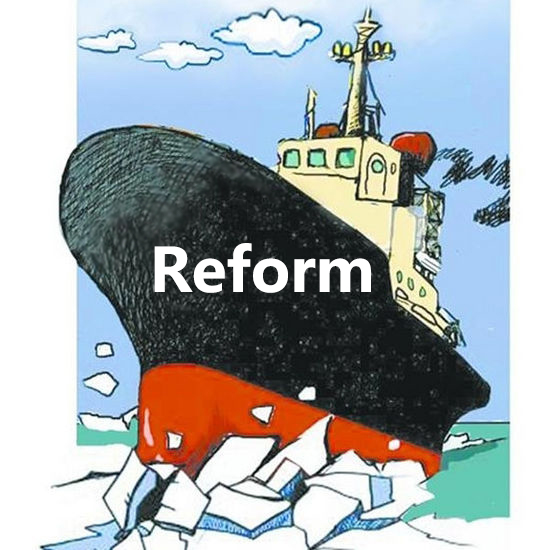
The supply-side reform will be led by a series of policies to improve public service, environmental protection, quality of production and further opening-up to the global economic system.[Photo/China Daily] |
Reviewing the process of the change from demand management to supply management in market economies will help us understand China's supply side management.
Western economies are typical free market economies, which suppose supply will automatically create demand, without leading to a crisis of overproduction.
But the Great Depression (1929-33) forced the US government to abandon its traditional non-interventionist policy and implement, albeit partly, John Maynard Keynes' theory, which says governments should intervene in the market through public investment and even deficit-stimulus to help economies recover. But the final outcome of policies based on Keynesianism was stagflation, that is, inflation without real economic development.
In the 1980s, former US president Ronald Reagan and then UK prime minister Margaret Thatcher implemented the policies of supply-side economics and monetarism. Monetarism advocates maintaining money supply according to the GDP growth rate and leaving other problems to the market. According to supply-side economics, the government should reduce taxes to encourage enterprises to foster innovation and boost public consumption.
And the implementation of supply-side management and the rise of the information industry have helped the US economy maintain sustainable and stable development for a long time.
Since the 2008 subprime crisis in the US, China has taken a series of demand-management measures to stabilize growth, including a 4 trillion yuan ($616.8 billion) stimulus package in 2008. These measures were taken on the assumption that the government could solve microcosmic problems through macro policies.
But the government intervention distorted factor prices and created further overproduction pressure. In other words, the structural adjustment didn't work. The marginal utility of the stimulus package declined sharply-the 4-trillion-yuan investment was not enough to maintain 7 percent growth today.
China now faces three major tasks. The first is structural adjustment. Economic development has two effects: structural effect and level effect. Structural effect refers to the improvement of industrial and product structure that may create more demand at a micro-economic level, which means enterprises could create new demand through supply.
Level effect refers to horizontal expansion of the original industrial structure. The structural effect is limitless, but the level effect is limited. Structural adjustment will lead to both upgrading and exit of excess capacity. But the lack of innovation capacity restrains upgrading while over stimulus prevents the exit of excess capacity.
The second is innovation. In the initial period of reform, China had plenty of industrial space, which allowed it to imitate successful economic models to grow rapidly. But its industrial space is now saturated and the marginal utility of imitation has sharply declined. To maintain a healthy growth rate, therefore, China has to create more demand through higher level innovation. But since innovation comes with uncertainties, it is better to allow enterprises to accomplish it.
How to create a suitable situation for enterprises so that they can foster innovation is a reform issue, because institutional reform can promote a technological revolution. Demand management's stimulus policy could delay such a revolution, while supply management is conducive to it.
The third is to strengthen economic vitality at the micro level. China's economy grew rapidly for three decades because of many favorable factors, such as the small GDP base, huge industrial space, cheap labor and resources, as well as the high-tide period of the global economy. But under the new normal, stable economic growth requires improving economic vitality, for which more attention should be paid to reforming supply management.
Economic development lies more at the micro level. Supply can create more demand at a higher level, which enables enterprises to play their due roles at the micro-economic level. So to implement supply-side management, reform should aim to increase enterprises' vitality, let market play the decisive role in resource distribution, and reduce government intervention in the market.
Government intervention in any form could reduce enterprises' vitality and distort factor allocation. Hence, the government should implement concise and stable policies and ensure fair competition for all kinds of enterprises, so that they can focus on creating new demand.
The author is a professor of economics at Renmin University of China.

Copyright 1995 - . All rights reserved. The content (including but not limited to text, photo, multimedia information, etc) published in this site belongs to China Daily Information Co (CDIC). Without written authorization from CDIC, such content shall not be republished or used in any form. Note: Browsers with 1024*768 or higher resolution are suggested for this site.
License for publishing multimedia online 0108263 Registration Number: 130349