 |
|
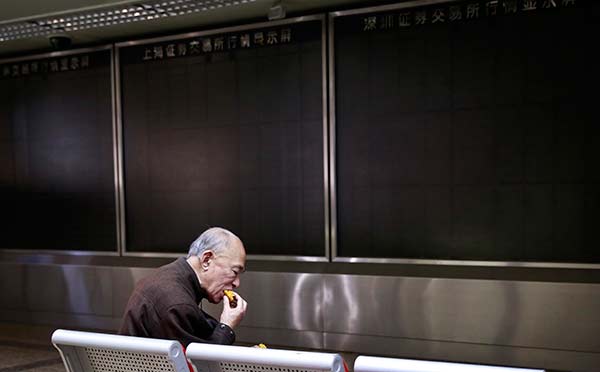
An investor eats packed lunch in front of a brokerage's blank trading board in Beijing on Jan 7 after 7 percent plunge triggered the new circuit breaker, ending the day's trading early.[Photo by Feng Yongbin/China Daily] |
"Cautiousness is necessary," Ran Lan, chairman of Shenzhen-based hedge fund Harmony Fund was quoted by the China Securities Journal as saying. "Like people in the north of the country who preserve vegetables when winter arrives, we have to keep some cash on hand and avoid being reckless."
While the short-lived circuit breaker mechanism has stoked much anger and sarcasm for functioning as a super-charged accelerator of a market slide, analysts said the timing of the introduction of the new system was unfortunate.
The continued depreciation of the renminbi to its weakest level since 2011 raised investors' fears about capital flight from China. Uncertainty over domestic big-ticket economic reforms, and disappointing economic data, have also weighed on investor sentiment. And there were few positives that could spur stock purchases.
In addition, there was initial anxiety over the expiry of the six-month ban on stock sales by major shareholders of blue-chip companies. (The regulator had imposed the ban back in June to stem the summer market rout.) That is not all. The approaching launch of a registration-based IPO system unsettled the market.
"In a period of intense market reform and economic restructuring, the risks of growth collapsing and deflation are rising," said Hong Hao, chief strategist at investment bank BOCOM International Holdings Ltd. "The market is capable of significant volatility, with or without the circuit breaker."
The repercussions of the A-share market meltdown were also felt by global markets. The United States S&P 500 Index tumbled by 6 percent last week, capping the worst-ever weekly start to a year.
Blackrock Inc, the world's largest asset management firm, said it expected greater volatility in the Chinese market and has adopted a cautious approach to increasing exposure to China. But the meltdown will unlikely presage a bear market in the US, it said.
"While unsettling, we view this as akin to the August scare rather than the start of a bear market, and believe the US market reaction may be overdone," it said in a press note.
Looking ahead, some analysts are anticipating fresh measures from policymakers in Beijing, including further monetary easing and intervention in the foreign exchange market to stabilize the currency, a key market-destabilizing factor.
"Whatever the reason for the sharper depreciation of the offshore yuan, we do not think that China will let the move get out of control and would prevent a sharper move or any panic in global markets" as it did following the August depreciation, admittedly doing so at a heavy cost, strategists at Barclays Bank said in a research note.
State-backed funds, the so-called national team, already appeared to have stepped in to purchase blue-chip stocks to propel the market. The CSRC said earlier that State-backed funds will not withdraw from the market and their role of stabilizing the market will not change.
Some analysts were wary that too much administrative intervention may run the risk of backfiring as the government rescue effort can only delay rather than reverse the declining trend.
The risk of policy uncertainty has also been spooking the market as the regulator's flip-flops on the circuit breaker rules have deepened investors' doubts about the government's capability to regulate the market.
With the removal of the circuit breaker soothing investors' nerves, a technical rebound is likely to take place this week and optimistic investors are betting on improvement of the game's rules by the regulator.
"We are a buyer on all three indices, namely the MSCI-China, CSI 300 and HSCEI, which are now below our full-year trough targets," said Wendy Liu, China strategist at Nomura Securities.
"It seems to us that the Chinese regulators are trying to strengthen the micro infrastructure of China's A-share market, while continuing to refine their adopted circuit-breaker mechanism, one step at a time," she said.
Views clash after market crash
"The triggering of the Chinese stock market circuit breaker twice in the first four days since it has been in effect is surprising, but may well indicate the trigger thresholds of 5 and 7 percent are too tight for the A-share market given its historical volatility level."
Blackrock Inc, the world's largest asset management company
"The sharp corrections in the Chinese equity and FX markets in the first week of 2016 highlight the challenges and concerns about China's rebalancing of its economy. We think subdued PMIs continue to signal weak underlying growth, and expect macro policies to stay accommodative in light of supply-side reform."
Chang Jian, Chief China economist at Barclays Bank Plc
"Investors have three macro concerns over Chinese equities now: adverse capital outflows and a further weakening renminbi, the US Fed rate hike cycle, and China's rising nonperforming loans and defaults."
Wendy Liu, China strategist at Nomura Securities Co
"The magnet effect created by the circuit breaker mechanism drained market liquidity and prompted investors' overreaction. The policy adjustment will likely bring back liquidity and the market will gradually stabilize with recovered investors' sentiment."
Wei Wei, analyst at Ping An Securities Co
"If the authorities respond to the latest volatility by extending, or even expanding, the policies that were introduced as part of the mid-2015 rescue package, it will serve only to delay the adjustment and push back the timetable for reforming domestic capital markets."
Tom Rafferty, Asia economist for The Economist Intelligence Unit
"The intensity of the market volatility will aggravate pessimism. Institutional investors are only participating in short-term trading at the moment with insufficient confidence in mid- and long-term holdings."
Ding Lei, fund manager at Hotland Innovation Asset Management Co

Copyright 1995 - . All rights reserved. The content (including but not limited to text, photo, multimedia information, etc) published in this site belongs to China Daily Information Co (CDIC). Without written authorization from CDIC, such content shall not be republished or used in any form. Note: Browsers with 1024*768 or higher resolution are suggested for this site.
License for publishing multimedia online 0108263 Registration Number: 130349