 |
|
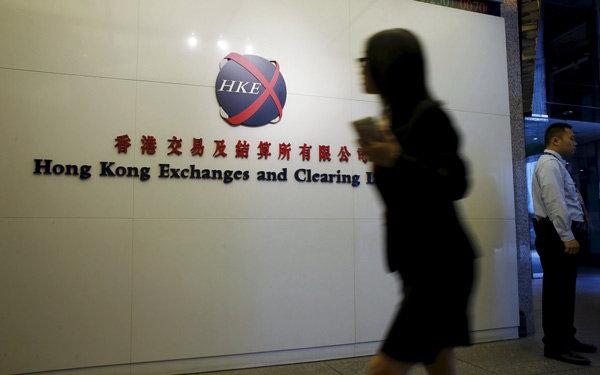
An employee walks into the Hong Kong Stock Exchange in Hong Kong.[Photo/Agencies] |
Stock investors are finally seeing value in domestic shares, but there's a twist: instead of wading back onto battered onshore exchanges, they've gone shopping for bargains in Hong Kong.
By doing so they are exploiting a long-standing market distortion that means the average share price of a dual-listed Chinese mainland company is currently 40 percent lower in Hong Kong than in Shanghai or Shenzhen.
The Hang Seng China Enterprises Index now trades at an average price-to-earnings ratio of slightly more than 6, much cheaper than broader Asian markets, which trade around 13, and the cheapest the HSCE has traded since December 2001.
The index of so-called H-shares is also trading below book value, meaning the average company's shares are pricing the business below its accounting value.
"Investing in HK stocks is the right choice, because the Hang Seng's current valuation is near historic lows; the kind of opportunity which has generated handsome returns previously," said Zhu Haifeng, a 31-year-old investor in Hubei province.
Zhu, who left his construction business to become a full-time stock investor, told Reuters he had boosted his Hong Kong equity exposure this year by roughly 70 percent to more than 6 million yuan ($912,100), while slashing his exposure to onshore stocks.
His Hong Kong portfolio, focused on dividend-yielding shares in mainland companies such as China Shenhua Energy and Television Broadcasting Ltd, now accounts for roughly 65 percent of his total equity exposure, he said.
Zhu is not alone. A number of measures show mainland money flowing into Hong Kong stocks, in part an unintended consequence of Beijing's extraordinary efforts to prop up its domestic market.
The E Fund Hang Seng China Enterprises Index ETF for example, an onshore exchange-traded fund managed by a quota system tracking the HSCE, has seen huge inflows from mainland investors this year.
Even as the HSCE has slumped roughly 15 percent year-to-date, the ETFs' assets under management have jumped 15 percent during the period, to 5.7 billion yuan.
And the number of fund units, which eliminates the effect of price fluctuations on fund value, has surged 37 percent this year, to 6.8 billion units, making it the second-largest ETF in Shanghai by that measure.
Yang Jun, fund manager at E Fund Management Co Ltd, said that typically ETFs grow in assets when the market is rising, but that has not been the case with HSCE Index ETF so far this year.
"Unit prices may be declining, but assets under management are growing rapidly," he said.
In another sign of change, the flow of money into Hong Kong from the mainland via the Hong Kong-Shanghai Stock Connect pilot program exceeded flows from Hong Kong into Shanghai last week for the first time since April.
The long-running price difference between Hong Kong and mainland exchanges reflects vastly different regulatory regimes-mainland's closed capital account means its markets are driven by sentiment among the domestic retail investors who dominate there, while open Hong Kong is more driven by international money managers and follows moves in global capital markets.

Copyright 1995 - . All rights reserved. The content (including but not limited to text, photo, multimedia information, etc) published in this site belongs to China Daily Information Co (CDIC). Without written authorization from CDIC, such content shall not be republished or used in any form. Note: Browsers with 1024*768 or higher resolution are suggested for this site.
License for publishing multimedia online 0108263 Registration Number: 130349