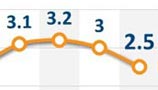
The current slowdown in China's economic growth is partly explained by what I called in my last article "a much overdue and entirely necessary long-term structural adjustment that inevitably shifts growth to a lower plane, almost certainly well below the current 6.9 percent per annum GDP expansion".
No economist I know ever expected China's economy to grow by 10 percent per annum for so many years. Japan had grown that fast some decades earlier, but then subsided into a miserable quarter century of stagnation that its government is still struggling to escape. The NIEs (Newly Emerging Economies) of East Asia: Hong Kong, Singapore and Taiwan also slowed after rapid growth spurts which lifted their populations from third-world to first-world average living standards.
Did China's economy really grow that fast? A statistical system that was designed for reporting to a central economic planner in the 1950s has found it difficult to capture the reality of such a vast economy. The official statistics probably tended to overstate growth during the occasional downturns (such as in the early and late 1990s) but understated growth during most of the three decades of economic reform when the economy was growing above trend. What economists term "anecdotal evidence" (i.e. what you can see with your own eyes, like new cars replacing old bicycles) strongly suggests that people in China have prospered greatly and rapidly.
The problem China now faces is that of the so-called "middle-income trap" faced by neighbors such as Malaysia, which, after successfully lifting themselves out of poverty, have failed to climb to the next stage of development, which would bring them level with the world's richest economies.
And China simultaneously faces the challenge of bringing its poorer inland areas up to the level of the developed coastal provinces. This challenge, though, is also an opportunity: levelling up the hinterland, along with continuing urbanization, can help maintain high national GDP growth rates for many years to come.
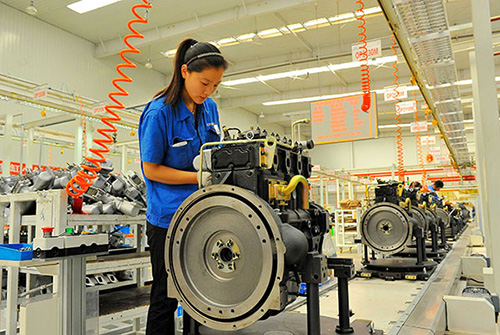
The great West Indian economist, Sir William Arthur Lewis, explained more than half a century ago how poor countries could develop with "unlimited supplies of labor", i.e. by transferring surplus labor from agriculture to urban industry. This theory applied particularly well to China after the return to family farming post-1978, when agriculture resumed its traditional efficiency. Hundreds of millions of people still classified as "peasants", but whose labor was not needed on the farm, migrated to the coast and became a massive workforce, powering the "world's factory" and building gigantic cityscapes.
As a result, China changed overnight from the world's most closed economy to one that has a higher percentage of trade in its GDP than most OECD Member countries. Huge trade surpluses resulted in a build-up of foreign-exchange reserves which peaked at USD3.8 trillion early last year. While that meant China could pay for many months (3 months is the usual benchmark) without having to export anything, it also meant that much national wealth was tied up in investment with a low return (mostly US treasury bonds).

Copyright 1995 - . All rights reserved. The content (including but not limited to text, photo, multimedia information, etc) published in this site belongs to China Daily Information Co (CDIC). Without written authorization from CDIC, such content shall not be republished or used in any form. Note: Browsers with 1024*768 or higher resolution are suggested for this site.
License for publishing multimedia online 0108263 Registration Number: 130349