 |
|
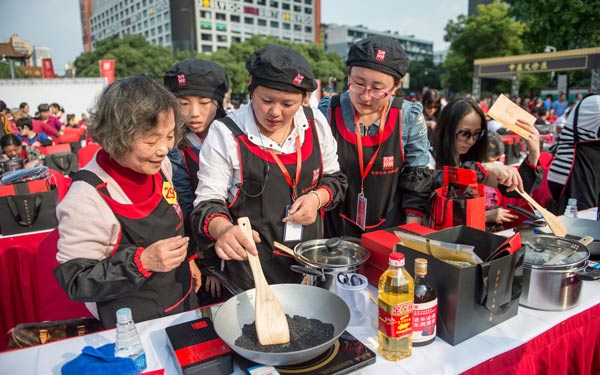
Women study cooking ejiao at a traditional Chinese medicine promotion event in Hangzhou, Zhejiang province. [Photo provided to China Daily] |
A shortage of donkey hides used to produce the traditional Chinese medicine ejiao has resulted in a deluge of imitations, with around 40 percent likely to be fake. Donkey-hide gelatin, known as ejiao in Chinese, is made by boiling the donkey's skin and refining the results into a tonic.
Ejiao is mainly taken by women who suffer from anemia, dry coughs or dizziness. The name was coined in Dong'e county in East China's Shandong province, where it was originally produced.
Around 5,000 tons of ejiao are produced annually in China, according to figures released by Shandong Ejiao Trade Association.
To realize such production, around 4 million donkey hides are needed each year. Annual supply in China is less than 1.8 million, meaning as much as 40 percent of the products claiming to be ejiao are counterfeit, according to the figures.
"With the current donkey hide supply, only 3,000 tons of ejiao can be manufactured each year," said Dong Shuguang, an ejiao consultant with more than 20 years experience in the industry.
Production of donkey hides has dwindled in China due to the animal's low fertility rate and long rearing period, prompting a 23 percent annual price hike. Last year, the average price for a complete donkey skin exceeded 2,600 yuan ($395).
As a result, people have begun using the skins from mules, horses, pigs and oxen to produce counterfeit tonics, according to Bu Xun from Shandong Academy of Agricultural Sciences.
"A donkey skin can cost up to 3,000 yuan, while horse and mule hides are only 200 yuan each. Pig skins are even cheaper," Bu said.
An industry insider said on condition of anonymity that some manufacturers sell the fake products to supermarkets or drug stores in remote counties or townships, or through online shops.
The revelation has shocked many, eliciting more than 16,000 comments on web portal 163.com by Jan 28.o supermarkets or drug stores in remote counties or townships, or through online shops.
The revelation has shocked many, eliciting more than 16,000 comments on web portal 163.com by Jan 28. Many commenters said they were surprised counterfeits were so common.
A precious TCM ingredient, ejiao is believed to have amazing medical effects and is widely used as a blood tonic in China. Official statistics show that 90 percent of the country's ejiao products are made in Shandong province.
Over thousands of years, ejiao has been incorporated into different products, including desserts, which can fetch between 400 yuan and 4,000 yuan.
According to Chinese medical documentation, ejiao is only effective when made with donkey hide, while the side effects of taking fake ejiao cannot be exaggerated. Fake ejiao made from horse skins has been known to cause miscarriages in pregnant women.
According to Bu Xun, it is very difficult to differentiate donkey skin from mules and horses, making it easy for manufacturers to get away with fake products. Current testing methods are ineffective, he said.
"China primarily tests for traces of oxen in ejiao products during inspection, so products made from the skins of pigs, horses and other animals flow into the market easily," Bu said.
He said that DNA tests could guarantee genuine ejiao products.
Some manufacturers in Shandong are already using DNA technology to ensure real products, according to Shandong Ejiao Trade Association.
A major ejiao producer, Dong'e Ejiao Co Ltd in Shandong, is taking the fight against fakes to the source. At 20 donkey farms across the country, the company is inserting chips into each animal, assigning them a unique ID. The chips contain information regarding the source, slaughter, transportation and sale of the donkeys. If customers find any poor quality products, they can report to authorities.
"The government should improve supervision, while the industry should be more disciplined," said Qin Yufeng, a State-level expert on ejiao production.
Qin said the government should support donkey breeders by offering subsidies to encourage more breeding.

Copyright 1995 - . All rights reserved. The content (including but not limited to text, photo, multimedia information, etc) published in this site belongs to China Daily Information Co (CDIC). Without written authorization from CDIC, such content shall not be republished or used in any form. Note: Browsers with 1024*768 or higher resolution are suggested for this site.
License for publishing multimedia online 0108263 Registration Number: 130349