 |
|
LI FENG/CHINA DAILY |
Second, take the tackling of overcapacity as an opportunity to accelerate economic restructuring.
The Chinese word for "crises" is made up of two characters, crisis and opportunity. Guided by our conventional wisdom that opportunities are embedded in crises and that we must be good at getting to grips with them, China is pushing through essential reforms and restructuring against all the odds.
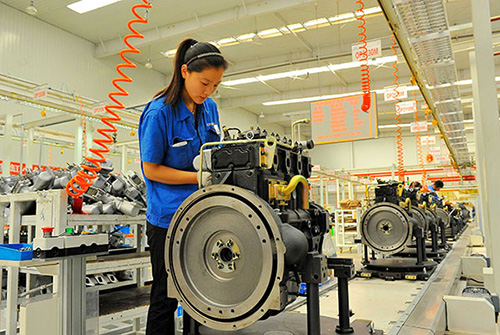
Being fully aware that much of China's industrial overcapacity is heavily concentrated at the lower end of the value curve, we have taken restructuring of the iron and steel sector as an important part of our endeavor to complete the difficult transition of moving China away from an investment-led economy to a consumer-oriented one.
China is actively restructuring the steel sector by eliminating outmoded capacity, creating exit strategies for "zombie companies" based on market rules, and encouraging promotion of innovation, technology, quality and management to meet production safety, energy consumption and environmental protection standards, and ensure the effective supply of high quality products.
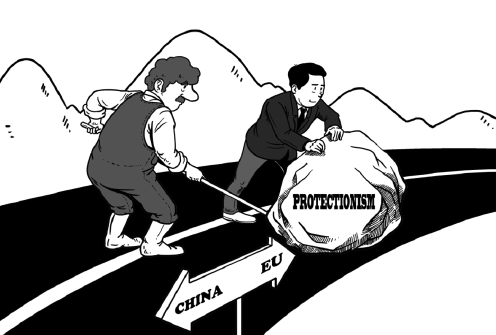
In addition, we have put in place stricter supervision over local authorities to guard against excess production and tendency to protect enterprises with favorable policies.
Third, support the training and relocation of workers for new jobs to minimize the negative impacts of transformation.
Like elsewhere in the world, the pressure of globalization and reform and restructuring has had impacts on Chinese society. Restructuring of the iron and steel sector has given rise to concerns and worries. Yet, there is a common understanding that change for the better involves a price and pain.
This time around, the Chinese government has taken measures to help redundant labor change career paths. Among other things, the central government is setting up a special fund to retrain workers and support local government efforts to reduce overcapacity.
And with rebalancing underway in the Chinese economy and with numerous new industries emerging, it is far easier now to get new and better-paid jobs than it was in the late 1990s when the country's inefficient State-owned industries were reformed.
This should also mean China can rely more on domestic consumption, instead of pouring yet more concrete in a country that has already built too many steel mills and cement plants.Fourth, stay the course of transformation against the headwinds.
Chinese attitudes to life have been shaped and molded by the country's great intellectual legacy of the past thousands of years, the values associated with Lao Tzu, Confucius and Mozi, including the wisdom that heaven maintains vigor through movement and that people should constantly strive for perfection of the self.
And the many vicissitudes we have gone through have taught us that maintaining the status quo and protecting underperforming sectors is only a temporary adaptation to circumstances rather than a long-term solution.
To be competitive we have to live with the world as it is and when the world changes we must be nimble and seize the opportunities that come with challenging circumstances and swiftly adjust ourselves in a pragmatic and clinical manner.
Undoubtedly, the unfolding new normal and structural transformation may be more painful and prolonged than the economic reforms of the late 1990s, since the restructuring of upstream industries will be more arduous and difficult.
Yet to achieve high-quality, efficient and sustainable growth is not an impossible dream. We are determined to endure the hardships and have the strength, determination and willingness to see its realization.
Fifth, China remains committed to opening-up to achieve international competitiveness and promote win-win cooperation.
In our globalized world, we are interdependent. This is not an option but a reality. Our progress and achievement has also resulted in growing for our global partners, especially our strategic partners.
Given this, we are working closely with our neighbors and the neighbors of our neighbors to establish the Silk Road Economic Belt and 21st Century Maritime Silk Road, which will forge closer economic ties, deepen cooperation and expand development in the Eurasian region, and ultimately create a community of common interests and shared destiny and responsibilities.
We are also expanding opportunities for both China and the EU by increasing market access and leveling the competitive playing field, including through negotiations on and early conclusion of the China-EU Investment Agreement.
We are advancing, as I mentioned before, economic reforms and restructuring, including financial sector opening, that would create a more rapidly growing Chinese market for EU goods and services by moving China toward more home-grown, consumption-led growth.
And we are strengthening cooperation on a range of international economic and financial issues, so that we are better able to work together on common global challenges.
Last but not least, global excess steel capacity calls for global action.

Copyright 1995 - . All rights reserved. The content (including but not limited to text, photo, multimedia information, etc) published in this site belongs to China Daily Information Co (CDIC). Without written authorization from CDIC, such content shall not be republished or used in any form. Note: Browsers with 1024*768 or higher resolution are suggested for this site.
License for publishing multimedia online 0108263 Registration Number: 130349