 |
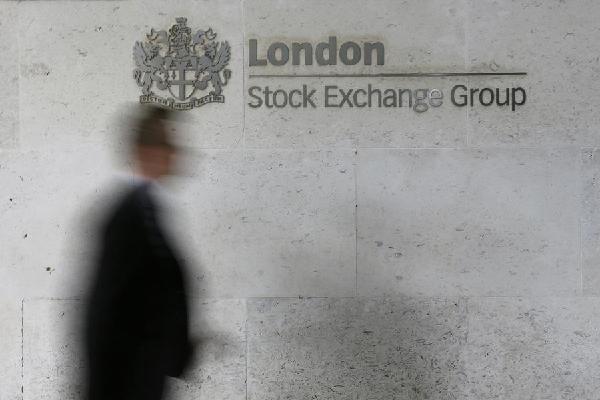
| A man walks past the London Stock Exchange in the City of London in this file photo. [Photo/Agencies] |
A new index, the FTSE China A-H 50 index, was last week announced by FTSE Russell, one of the leading global index providers, to represent the largest companies listed on the Chinese mainland and in Hong Kong.
Deutsche Asset Management together with Harvest Global Investors, issued FTSE China A-H 50 Index Exchange Traded Funds (ETFs) to capture the price differential between China's domestic A-shares, usually traded on the Shanghai and Shenzhen stock exchanges, and H-shares, which are listed on the Hong Kong market.
On the same day, Morgan Stanley Capital International (MSCI), a leading global benchmark index provider, said it would revive talks on including China A-shares in its global emerging markets index, though MSCI removed China from its review process last June.
In the financial markets, an index is an imaginary portfolio of securities representing a particular market or a portion of it. Stock market indexes are used to construct ETFs whose portfolios mirror the components of the index.
The FTSE China A-H 50 index lists the largest 50 China A-shares companies by market capitalization but tracks the lowest-priced share class between the A and H share classes. Dual-listed Chinese mainland shares often trade at different prices, even though the two types of shares enjoy the same voting rights and dividend payments.
"This is the first ETF of its kind listed in Europe," says Marco Montanari, Deutsche Asset Management's Head of Passive Asset Management, Asia-Pacific.
Twenty-eight of the largest 50 dual-listed Chinese companies currently trade at an average 22 per cent premium on the mainland in relation to their Hong Kong price, says Montanari.
The persistent price anomaly is due to the various capital control measures implemented by the Chinese government, says Hu Jing, investment manager at Arbuthnot Latham & Co, a private bank in London, adding "as the domestic capital market opens up gradually, the pricing difference can disappear."
The creation of the new ETF sends out a clear signal that the integration of Chinese capital markets in set to continue regardless of short term volatility, according to Ben Kumar, investment manager at Seven Investment Management, a London-based financial company founded in 2002.
"A gradual inflow of foreign investor capital would allow domestic Chinese capital to begin investing worldwide. The long term aim is that the A-H premium disappears, and ultimately Hong Kong listed stocks either trade in line with mainland counterparts, or vanish completely," he says.
Kumar warns there are two issues to be aware of, saying if the premium of A shares over H shares persists for a long time or even gets wider, the benefits of the index are somewhat limited.
Taking ICBC as an example, Kumar said in March last year the bank's stock was worth USD 0.70 in Hong Kong and USD 0.705 in Shanghai – a difference of 0.005USD. Yet today the difference between the two is USD 0.14, and the discount in Hong Kong has widened – a cheap share has become even cheaper, relative to its mainland counterpart.
"Additionally, even if the premium closes, it could be in an environment where both markets are declining rapidly – an investor might have better relative performance, but still lose in absolute terms," he explains.
Despite the turmoil in the Chinese stock market, China ETFs generated 4.1 billion pounds ($5.86 billion, 5.15 billion euros) on the London Stock Exchange (LSE) last year, a 73 percent rise compared to the year before, according to a LSE report.
Analysts say this is a strong indication that China is making itself felt on the global stage; Kumar says international investors are beginning to realize that the Chinese assets in their portfolios are proportionately small when compared to the size of the Chinese economy, adding "if and when popular indices begin to include a meaningful weight to A-shares, people do not want to be playing catch up."
In February, as a commitment to further open financial markets, the Chinese government granted an extra $81 billion or so in quotas under the Qualified Foreign Institutional Investor (QFII) program, for overseas investment in China's domestic stocks and bonds.
QFII, started in 2002, is a program that allows certain licensed international investors access to the Chinese mainland stock exchanges using foreign currency.
MSCI says in a statement "The reopening of the consultation follows the recently implemented changes by the Chinese authorities aimed at enhancing the accessibility of the China A-shares market for international institutional investors."
As MSCI is widely used as a benchmark, and a vast amount of money tracks its indexes globally, industry analysts say MSCI's inclusion will be more meaningful and have more impact than FTSE Russell's new announcement.
"New indices created by FTSE Russell currently have zero assets attached to them, so flows will depend on investors starting to use them, whereas MSCI is an enormous pool of existing assets," says Robert Davis, senior portfolio Manager of Brussels-based NN Investment Partners.
MSCI has promised that the process would be mindful of investor feedback, so Davis anticipates the main concern for a delay would be that after the debacle of the A-share bubble and crash last year, the market, along with its regulation, is judged as insufficiently mature to be included in mainstream indexes.
Still, Davis is confident that MSCI will include China A-shares into its global benchmark, but perhaps with a low ‘inclusion factor' so the initial weights in the indexes will be very small.
To contact the reporter: wangmingjie@mail.chinadailyuk.com


Copyright 1995 - . All rights reserved. The content (including but not limited to text, photo, multimedia information, etc) published in this site belongs to China Daily Information Co (CDIC). Without written authorization from CDIC, such content shall not be republished or used in any form. Note: Browsers with 1024*768 or higher resolution are suggested for this site.
License for publishing multimedia online 0108263 Registration Number: 130349