 |
| LI FENG/CHINA DAILY |
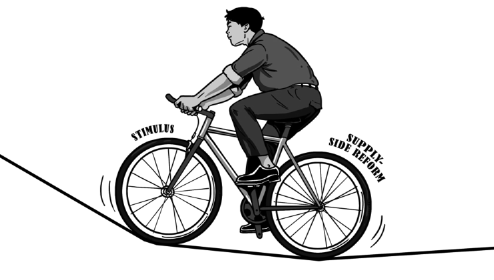
Since last November economists and the media alike have been hailing supply-side structural reform as a groundbreaking solution to China's economic woes. The logic goes, demand-side policies, in the form of Keynesian stimulus measures, are useful only for resolving short-term and aggregate problems. But since China's problems are long term and structural, the country should focus on supply-side structural reform, even if it means accepting slower GDP growth. Is this the right approach?
GDP growth is generated via the interaction between the supply side and the demand side of the economy. For example, investment in human capital enables innovation, the products of which create demand and, in turn, economic growth. Demand-side policy and structural adjustment are not mutually exclusive. In aggregate terms, growth of supply determines growth potential, and growth of demand determines the use of that potential. To change the economic structure and growth pattern, first the structure of demand must be changed.
For China, the supply side should be driven more by innovation and creation, rather than by increasing inputs. On the demand side, it should be driven more by domestic consumption, instead of investment (especially in real estate) and exports. But this shift is proving difficult, as structural factors cause China's long-term potential growth rate to fall; the economy now seems set to fall below that lower rate this year.
All of this suggests that continued structural adjustment is needed in China. But the reality is that China has been engaged in such adjustment for a long time, with unsatisfactory results, indicating that complementary demand-side policies may be needed. Moreover, while slower growth is unavoidable because of adjustment, there is a limit to how low a growth rate China can accept. With China's growth having already reached a 25-year low in 2015, that threshold may not be far off.
To be sure, many believe that China's growth rate will stabilize in the second half of 2016. If it does, China's leaders could probably concentrate on structural adjustment without considering additional stimulus. But there is good reason to believe that China's growth rate will continue to decline this year.
The fact is that China remains in the grip of deflation, with prices and output in a downward spiral. Despite a slightly positive consumer price index, the producer price index has been falling for 47 months in a row. Moreover, the GDP deflator has been negative since the beginning of 2015.
Two types of deflation spirals are currently at work in China. There is the overcapacity-deflation spiral, in which overcapacity pushes down the producer price index, leading to falling corporate profitability. Then there is the debt-deflation spiral, in which falling producer price index causes real debt to rise, again weakening corporate profitability. In both cases, firms are driven to deleverage and reduce investment, a response that leads to more overcapacity and further declines in the producer price index. Furthermore, given that China's corporate debt is already very high, the increase in real debt may have devastating consequences for financial stability.


Copyright 1995 - . All rights reserved. The content (including but not limited to text, photo, multimedia information, etc) published in this site belongs to China Daily Information Co (CDIC). Without written authorization from CDIC, such content shall not be republished or used in any form. Note: Browsers with 1024*768 or higher resolution are suggested for this site.
License for publishing multimedia online 0108263 Registration Number: 130349