 |
|
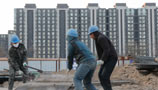
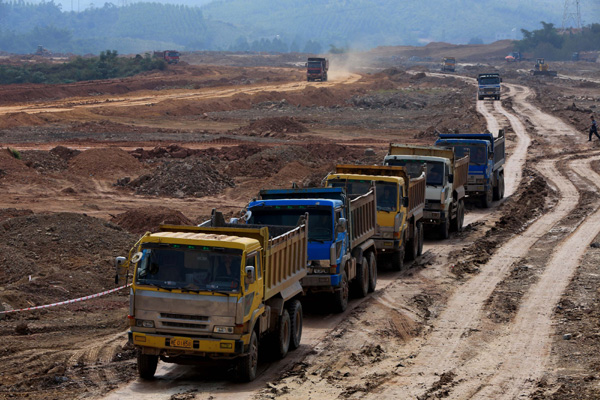
A construction site in Guangxi Zhuang autonomous region, Oct 20,2013.[Photo by Tan Kaixing / Asianewsphoto] |
The answer is: two pieces of undeveloped land in Shenzhen, or 45.6 billion yuan ($6.9 billion). That's the amount of new stock -- 20.6 percent of all Vanke's shares after the issue -- that Vanke, the Fortune Global 500 housing giant, hopes to give to the land owner in exchange.
And how much leverage are the developers taking on?
Sunac, the country's ninth largest developer, bought a piece of land on the outskirts of Shanghai for 3 billion yuan last month, a price just short of its yearly net profit of 3.3 billion.
Such are the great lengths that China's real estate industry is going to for urban land, as prices in tier one cities - Beijing, Shanghai, Shenzhen and Guangzhou - and tier two cities, notably Nanjing, Suzhou, Hefei and Xiamen, go through the roof.
Last month, all three plots designated for residential development in Shanghai were auctioned off to developers at more than twice the starting price.
In Hefei, capital of Anhui province, ten out of a dozen land plots reached over three times of their initial price, with one attracting bids from twenty developers. The city, whose entire fiscal revenue was 100 billion yuan last year, netted 9.6 billion in the May 31 auction.
Another eye-catcher is the valuation of individual plots, with billion-yuan price tags continuing to emerge. In the single highest bid thus far this year nationwide, Cinda Real Estate paid 12.3 billion yuan for a lot in Hangzhou, capital of the coastal Zhejiang province, late last month.
Higher price expected
"The flour is sometimes more expensive than bread," analysts said, using a Chinese proverb to describe how undeveloped land is more expensive than existing apartment buildings nearby.
In Shanghai's western suburb of Sijing, a lot sold last month for 40,000 yuan per square meter - twice the typical price only six months ago. Nearby apartments are priced at 24,000 to 31,000 yuan per square meter.
Higher land prices, in turn, trigger rises in the price of neighboring housing. In the Sijing area, the first batch of apartments in a residential project were sold for around 28,000 yuan per square meter: The second batch starts at 34,000 yuan.
"Expensive land carries big risks. The most expensive land in some cities either loses money or breaks even,"said Zhang Dawei, chief analyst of Centaline Property.
Developers are betting that this year's sales recovery will eventually bring them a fat return. Destocking the housing inventory is an economic priority and, to that end, it is now much easier to get a mortgage.
"Housing inventories continue to fall every month, with the level in major cities now lower than half a year ago," said Li Jiao, a senior statistician with the National Bureau of Statistics.
"Risks in tier one and two cities are relatively low and we can still make bets," said Zhang Yang, investment director of property developer Shimao Group.
Stay in the game
As prices skyrocket, more land is falling into the hands of the biggest developers. "They are either publicly-traded or state-owned," said Zhang.
According to Centaline, 27 of the 50 most expensive plots from January to May 23 went to state-owned developers. Only 8 plots were sold to developers who are not publicly listed.
State-owned companies have better access to bank credit, and listed companies' enjoy significantly lower fund-raising costs.
One prime example is Cinda Real Estate, which raised national eyebrows when it splashed out 12.3 billion on this year's most expensive plot. Cinda is listed on the Shanghai Stock Exchange and controlled by China Cinda Asset Management, one of the country's Big Four bad-loan banks.
"We are not short of money, but short of projects," said Lin Feng, president of Hong Kong-listed developer CIFI. CIFI pays less than 5 percent interest annually on its debt.
"Overpayment is nothing scary,"said Zhang Yang of Shimao Group. "The biggest fear is that we have no land in hand and won't have chips to play. What we do is to try to stay in the game," he said.


Copyright 1995 - . All rights reserved. The content (including but not limited to text, photo, multimedia information, etc) published in this site belongs to China Daily Information Co (CDIC). Without written authorization from CDIC, such content shall not be republished or used in any form. Note: Browsers with 1024*768 or higher resolution are suggested for this site.
License for publishing multimedia online 0108263 Registration Number: 130349