 |
|
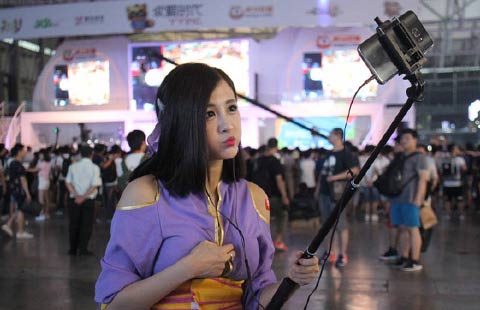
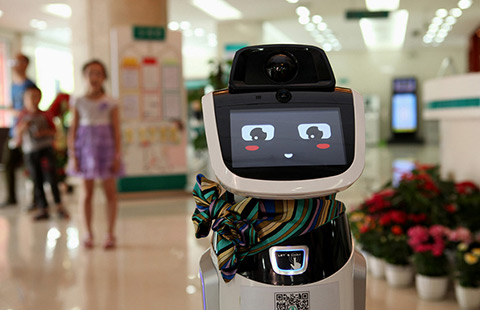
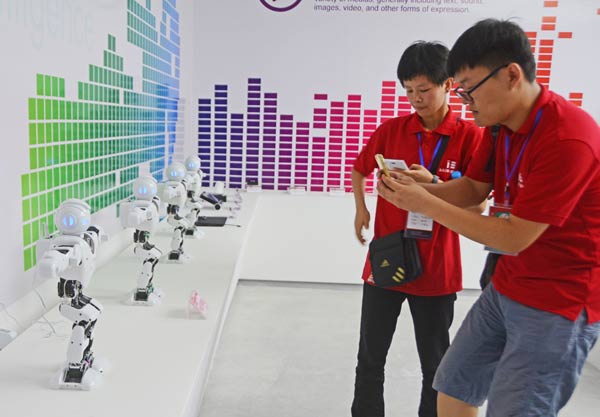
Visitors take photos at a creative industrial park in Dafeng District, Yancheng, East China's Jiangsu province, July 22, 2016. [Photo/IC] |
BEIJING - Chinese cities, with their ubiquitous science and technology parks and entrepreneur roadshows, are fiercely competing to win reputations for accommodating business startups and mass innovation.
China is aiming to become an innovation powerhouse by 2020, according to a national program for science and technology that was recently adopted as part of the 13th Five-Year Plan for national socioeconomic development.
The plan, which Premier Li Keqiang said "fully demonstrates that we have given top priority to innovation," adds fresh impetus to a national movement of supporting and encouraging innovation since 2013.
So far, more than 200 makerspace projects, 1,600 business incubators, and 129 high-tech zones and science and technology parks have been created nationwide. They help concentrate resources for innovation and nurturing start-ups launched by business executives, scientific researchers and even college students.
"The local government has given much attention to and support for entrepreneurs," said Yang Rong, co-founder of XGimi Technology, a star tech start-up in the western Chinese city of Chengdu.
Her company has benefited from favorable government policies such as free work space, financial awards for patent approval, and communication platforms with global investors and entrepreneurs, which helped kick-start XGimi at an early stage.
In less than three years, the firm has grabbed more than half the market share for miniature, home-theater projectors in China, and shipped more items than the South Korean electronic giant LG, its main competitor in the global market.
According to data released by the local government, the total of newly registered enterprises jumped 34 percent in Chengdu in 2015 compared with the previous year, with the number of invention patent applications up by more than 35 percent in the same period.
Cutting red tape
China is undergoing a transition from a labor-intensive "Made in China" model to an innovation-driven "Created in China" model, Francis Gurry, director-general of the World Intellectual Property Organization, told Xinhua.
In the southern city of Shenzhen, high-tech manufacturing already accounts for 66.2 percent of the city's total industrial value-added income. Shenzhen switched to innovation earlier than other big cities, and has a free business environment, strong policy support for start-ups, as well as efficient venture capital.
Across China, local governments have taken the opportunity to deepen reforms, cut red tape and remove barriers to innovation.
Chengdu, for instance, has simplified its procedures for business registration, worked aggressively to protect intellectual property, and spearheaded reforms in universities to promote technology transfer and commercialization.
In another southern city, Guangzhou, companies buying scientific and technology patents can seek government subsidies of 5 percent of the value of research result transactions. Newly established tech companies can also apply for subsidies of up to 50 percent of their rent for three consecutive years.
"We encourage enterprises to cooperate with universities and research institutes," said Chen Yanling, an official with the municipal government of Guangzhou.
Global outreach
From inland cities to the coast, local governments have also stressed global outreach to foster creativity.
A high-tech development zone in the eastern city of Shanghai opened an enterprise park in Boston in February to promote China-U.S. technology innovation. The park, to be operated by a joint venture, will pool innovative resources from universities, enterprises and institutes in both countries, and integrate research and development incubation, industry, services, trade and finance.
In Chengdu, a transport, business and technology hub in southwest China, a global innovation and entrepreneurship fair was held last year, the first of its kind in the country. The event attracted government officials, investors, research institutes and innovative enterprises from 30 countries and regions.
Up to 109 projects from a total of 2,686 participants have changed hands as a result, with transactions totaling 5.32 billion yuan (about $817 million).
The Canadian astrophysicist and 2015 Nobel laureate Arthur B. McDonald, who attended the second fair held in June, called Chengdu an international city with great appeal. "It's very suitable for start-up companies to invest and grow here," he said.
Moreover, the city hosted the G20 finance ministers and central bank governors meeting on July 23-24, the most high-profile international meeting for Chengdu so far. "Hosting the meeting will further boost the city's reputation globally," said Li Houqiang, head of the Sichuan Provincial Academy of Social Sciences.


Copyright 1995 - . All rights reserved. The content (including but not limited to text, photo, multimedia information, etc) published in this site belongs to China Daily Information Co (CDIC). Without written authorization from CDIC, such content shall not be republished or used in any form. Note: Browsers with 1024*768 or higher resolution are suggested for this site.
License for publishing multimedia online 0108263 Registration Number: 130349