 |
|
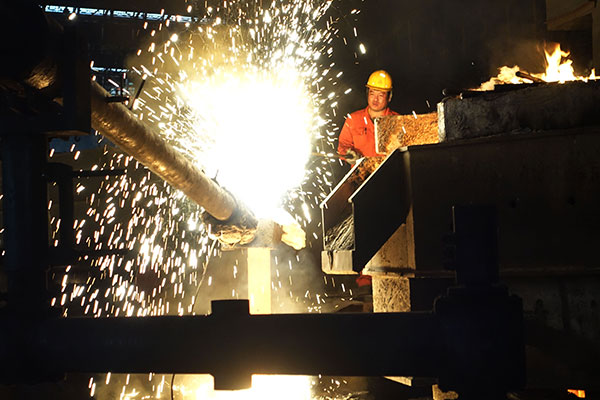
Workers at a steel factory in Dalian, Liaoning province. [Photo/China Daily] |
BEIJING - Deepening fundamental reforms of China's State-owned enterprises (SOEs) is key to cutting industrial overcapacity, according to experts.
The view echoes a statement released by the Political Bureau of the Communist Party of China Central Committee after a meeting Tuesday.
The thrust of such reforms is to improve SOEs' governance mechanism in accordance with market rules and let market forces play a fundamental role in allocating resources, experts said.
Loss-making "zombie enterprises" in glutted industries that cannot make a turnaround or counteract structural adjustment should be phased out.
A report released on Wednesday by Renmin University of China pinpointed "zombie enterprises" as a major cause of overcapacity.
"Most SOEs operate in traditional heavy industries, which means even greater difficulties in generating profits, slashing overcapacity and liquidating 'zombie enterprises,'" said Xiao Yaqing, head of the State-Owned Assets Supervision and Administration Commission of the State Council, in late June.
Some SOEs are unwilling to innovate and lack vitality as well as original technology or good branding, Xiao said.
China's steel and coal industries, which have long been plagued by overcapacity, are a case in point, having increasingly felt the pinch in the past two years as the economy cooled and demand shrank.
China's current annual steel production capacity is some 1.2 billion tonnes. China stated in its five-year (2016-2020) plan it would axe capacity by up to 150 million tonnes, equivalent to Japan's 2015 total output.
It also expects to slash coal production capacity by some 15 percent in the five-year period.
The task is daunting. Local governments and SOEs completed only 29 percent of the coal overcapacity reduction target for 2016 in the first six months, according to the National Development and Reform Commission on Tuesday.
"The key is to follow market rules," said Li Xiaohua, a researcher at the Institute of Industrial Economics of the Chinese Academy of Social Sciences, a leading think tank.
Citing overcapacity as a problem for both the public and the private sectors, Li said the difference is that private enterprises are more market-conscious, reacting through downsizing, shut-downs or bankruptcy when they are unable to generate a profit.
But "zombie enterprises" survive on financing from the government and banks, as these SOEs are important to local stability and the assessment of officials, according to Wu Xiaoling, vice chairwoman of the Financial and Economic Committee of the National People's Congress.
"Unsuccessful clearance of 'zombie enterprises' poses a major threat to China's economic structure," Wu said, who went on to call them "a gigantic waste of market resources."
The government needs to reduce regulation and be more cautious in applying industrial policies, while banks should be free from administrative influence when making lending decisions, according to the Renmin University of China report.
Nie Huihua, a key author of the report, said the government should keep policy consistent to eliminate the companies' hopes of receiving policy support in the future.
The SOEs need to step up efforts to improve administration mechanisms, including motivation for management and staff, he said.
While removing "zombie enterprises," China is resorting to SOE mergers to create more global powerhouses and avoid cut-throat competition, in addition to restructuring of redundant industries to aid supply-side reform, said Li Jin, chief researcher with the China Enterprise Institute.
China's two major steel SOEs, Wuhan Iron and Steel and the Shanghai-based Baosteel, announced restructuring plans in late June aimed at reducing excess steel capacity and improving market competitiveness.
Mergers and restructuring will continue to take center stage in the reform and development of SOEs, and such reforms of the centrally administered SOEs are accelerating, Li Jin said.


Copyright 1995 - . All rights reserved. The content (including but not limited to text, photo, multimedia information, etc) published in this site belongs to China Daily Information Co (CDIC). Without written authorization from CDIC, such content shall not be republished or used in any form. Note: Browsers with 1024*768 or higher resolution are suggested for this site.
License for publishing multimedia online 0108263 Registration Number: 130349