 |
|
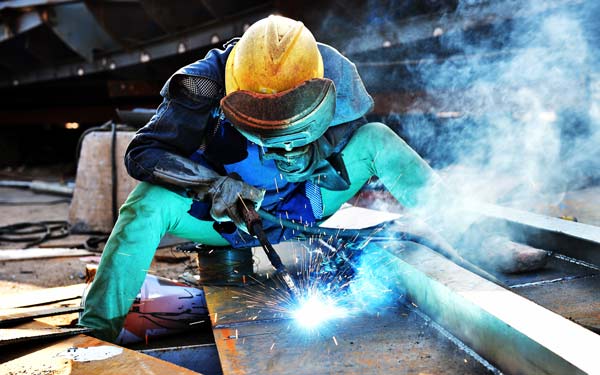
A welder works at a steel plant in Lianyungang, Jiangsu province. [Photo by Si Wei/China Daily] |
Local governments in China should strike the right balance between economic growth and reforms. Else, development would be slow and lack balance, preventing the nation from meeting its capacity reduction targets, economists and analysts have warned.
"Efforts to cut overcapacity lagged far behind expectations in the first seven months (of this year), with notable imbalances in progress across regions and factories," said Xu Shaoshi, head of the National Development and Reform Commission.
Other experts said regional disparity in development has a lot to do with different local economic structures and hurdles to efforts to cut overcapacity.
But, local governments' attitudes also play an important role, they said.
Data from the Ministry of Industry and Information Technology shows that the nation's major steel production bases, including Hebei, Liaoning, Hubei provinces, accomplished only 10 to 35 percent of yearly targets (for cuts in capacity), while Inner Mongolia autonomous region, Jilin and Heilongjiang provinces have yet to make any progress.
Meanwhile, some regions achieved remarkable progress. For instance, Jiangsu has finished 80 percent of its set work already, while Beijing accomplished more than 50 percent.
"It's a lot easier for developed places, which have been relying more on the services sector for years, to finish tasks and drive growth," said Wang Youxin, an economist with the Institute of International Finance, a think tank under the aegis of Bank of China. "They face light workload in the initial phase and fewer problems related to restructuring."
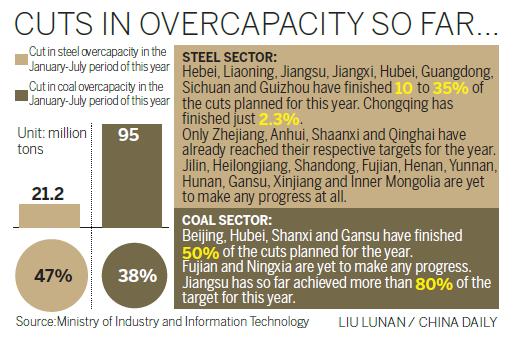
For instance, Jiangsu's target for this year was to cut its steel capacity by 3.9 million tons, which is way lower than Hebei province's target of 17.36 million tons.
Xia Nong, an official with the NDRC, said that restructuring is the future trend.
"Restructuring would help resolve debt issues, and the government would help companies go through the process."
An industry insider who sought anonymity said provinces' different economic structures show that less-developed regions tend to have clusters of heavy industries, and fall far behind in growth, dragging down the nation's pace.
"There's nothing much that a weak performer can learn from others," Wang said, referring to the case of Hangzhou Iron & Steel Group Company, in Zhejiang province, that has been recently appreciated by the NDRC.
The company shut down a unit with a capacity to produce 4 million tons of steel per annum and relocated 12,000 workers in only 150 days.
High value of land in Hangzhou would help the company repay its debts. The government has less pressure to relocate workers, Wang said.
Given the current strong economic downward pressure, "some (local) governments would rather stick to the old habits of fueling the old engine (of growth) at the expense of reforms", he said.
Economic growth in the lagging northeast rustbelt region has a ticked up a tad in the first half of this year, he said.
Data from the NDRC shows that the region's economy grew 2.2 percent year-on-year in the January-June period.
But economic growth fueled by sectors riddled with overcapacity is not sustainable given the weak domestic demand, said Zhao Changwen, a senior official with the State Council's Development Research Center, a government-backed think tank.
Zhao suggested that regions with heavier workloads should lower local GDP targets in order to create an appropriate macro environment.
"Less importance placed on economic growth helps prevent governments from approving any new projects that would expand steel or coal capacity," said Zhao.
Zhang Lin, a senior analyst with dz18.com, an e-commerce platform for the steel supply chain, said that with less pressure to boost growth, local governments are more likely to seek more targeted solutions and accelerate the pace of development.
"Local governments know better than anyone else where (the real) problems lie," said Zhang. "It (the ability to solve problems) depends on their attitudes to implementing reforms."


Copyright 1995 - . All rights reserved. The content (including but not limited to text, photo, multimedia information, etc) published in this site belongs to China Daily Information Co (CDIC). Without written authorization from CDIC, such content shall not be republished or used in any form. Note: Browsers with 1024*768 or higher resolution are suggested for this site.
License for publishing multimedia online 0108263 Registration Number: 130349