 |
|
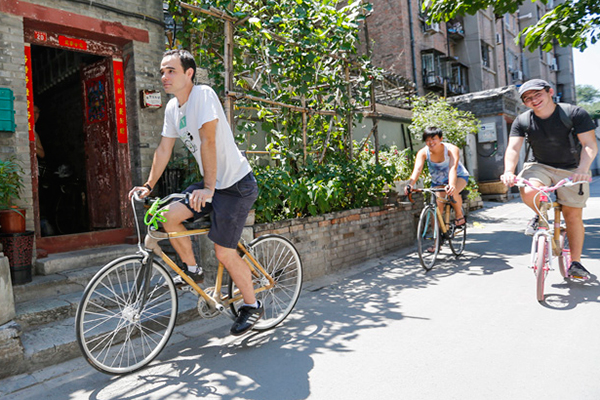
David Wang and his friends ride bicycles in a hutong in Beijing, July 13, 2016. [Photo/Xinhua] |
Innovation makes humble personal vehicle trendy and revives the flagging bike sector
Only three decades ago, Beijing was known worldwide for its large traffic dominated by millions of bicycles. The two-wheeler was then the primary mode of personal transport.
In recent years, the number of bicycles in China's main cities has gradually decreased as Chinese consumers grew affluent enough to be able to afford cars.
The number of bicycles in China is expected to decrease to 350 million in the next three years from 370 million in 2015, according to market research firm Frost & Sullivan.
Yet, the introduction of innovative, premium two-wheelers is helping the personal vehicle industry to stay profitable, despite the gradual decrease in the number of bicycles.
Market consultancy Euromonitor International estimates that the market size of the bicycle industry in China will increase to 78.34 billion yuan in 2020 from 57 billion yuan in 2015.
So, to make the Chinese pedal again and to ride the expected boom in sales, a group of foreign entrepreneurs has introduced innovative bikes.
Its story began in 2009, when German-born Ines Brunn decided to quit a high-paying job in Beijing to focus on her true passion-bicycles.
She wanted to show the locals that bicycles could be trendy. She opened her own bike store Natooke in a traditional hutong (narrow lanes) in the Chinese capital.
"Back then, I got the feeling that Chinese people were trying to be modern and push away the past," said Brunn, CEO of Natooke. "So, anyone who had received an education or earned a reasonable salary did not want to be associated with a bicycle."
At that time, fixed-gear bikes were popping up in large cities like New York, Tokyo and London but were missing in the streets and bicycle shops of China.
Natooke claims to be the first store to have introduced fixed-gear models in Beijing. It also said it pioneered bike customization.
In her store, customers can create their own bikes from scratch to suit their personality, tastes and needs.
Natooke's fixed-gear bikes retail from 2,900 yuan ($430). The firm also offers a wide variety of cycling accessories such as smog-protection masks.
Other services include cycling events to promote the use of clean transportation.
Although Natooke refuses to disclose revenue figures, it said that sales have kept growing as more Beijing residents are gradually discovering the benefits of cycling.
The store's success was such that other investors wanted to adopt the Natooke customization concept in other cities in China, to profit from the fresh popularity of bicycles.
"There was one year in the past when at least two people would visit the store every week to discuss our expansion plans," said Brunn. "However, most of them have no background in cycling. They just want to do it (enter innovative bike business) for the money."
Finally, in 2012, two Americans who shared her passion convinced her to take the brand to Chengdu, in Sichuan province.
Although her business is progressing well, she said that online competition is currently very strong, offering cheaper prices for lower quality products.
"I do believe changes in consumer tastes and preferences will shape new thinking on bikes and that the Chinese will be willing to buy more expensive and better bikes," said Brunn.
Neil Wang, global partner and China president of Frost & Sullivan, agreed. "High-end electric scooters and high-end bicycles are becoming trendy in big cities in China."
Like Brunn, US-born David Wang left his job in 2014 as a market researcher in China to focus on his passion-bikes. The difference is, he created Bamboo Bicycle Beijing, a company that teaches locals to build their own sustainable bikes using bamboo.
"I thought that I could add more cultural value by helping people to build their own bike instead of just selling them," said Wang. 'Young people in China don't just want to consume a new product, they want to experience new things."
So far, the company has taught more than 400 people to create their own green bikes and notes that the community interested in taking part in its workshop and activities keeps growing.
The company charges 2,000 yuan to participate in its all-included do-it-yourself workshops. An average of 4-6 people learn every week how to build their own bikes at workshops in a traditional hutong.
Although the firm's profits are still slim, Wang hopes its revenue will grow on the back of collaborations with schools and companies.


Copyright 1995 - . All rights reserved. The content (including but not limited to text, photo, multimedia information, etc) published in this site belongs to China Daily Information Co (CDIC). Without written authorization from CDIC, such content shall not be republished or used in any form. Note: Browsers with 1024*768 or higher resolution are suggested for this site.
License for publishing multimedia online 0108263 Registration Number: 130349