 |
|
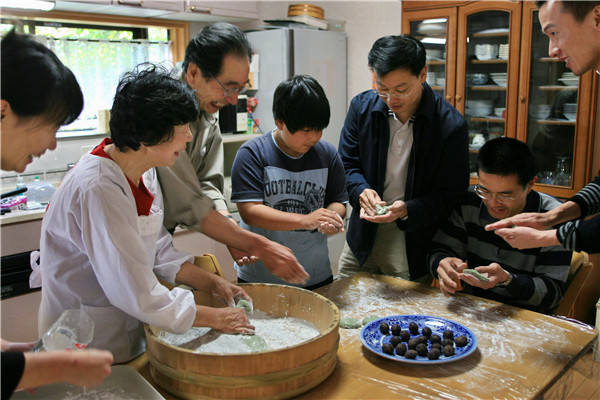
Chinese youth learn how to cook local food in Takatsuo in Japan. They get to experience the Japanese culture by staying in local bed-and-breakfast facilities.PROVIDED TO CHINA DAILY |
Shortage of hotels creates demand for B&B units; guesthouses mushroom in Japan
The global economic growth has been sluggish, but not the Chinese investors' shopping spree for assets worldwide. They are now eyeing the Japanese property market, especially bed-and-breakfast facilities.
In a sense, it marks the evolution of Chinese shopping in Japan. For long, the Chinese have been loading up on the Japanese consumer goods ranging from electronic toilet seats to rice cookers and cosmetics.
Now, it's Japanese property. Prices surged nearly 30 percent in the last couple of years on the back of demand for hospitality-related realty, particularly B&B units, from Chinese investors.
Property agencies in Japan think Chinese investors are convinced millions of Chinese tourists visiting the Land of the Rising Sun every year present great investment opportunities.
They are pumping in big money into the Japanese property market.
In July alone, a record 2.29 million travelers visited Japan, bulk of them from the Chinese mainland, according to the Japan Tourism Agency.
In the first half of 2016, 11.7 million foreigners visited Japan, up 28 percent year-on-year. Of them, a little over 3 million were from the Chinese mainland.
Every year, about 20 million foreigners visit Japan. The Japanese government is aiming to receive 40 million visitors by 2020, the Tokyo Olympics year. By 2030, it is targeting to receive 60 million visitors.
In some bustling tourist attractions like Tokyo and Osaka, there is a serious shortage of hotels. Last year, the occupancy rate of hotels reached 82.3 percent in Tokyo, and 85.2 percent in Osaka, according to the JTA.
A 21st Century Business Herald report quoted UBS Securities in Japan as saying that if "the occupancy rate of a hotel reaches 80 percent, the hotel is regarded as operating with full load. If visitor numbers rise by 5 million a year, the hotels in Tokyo and Osaka won't be enough".
Inadequate number of hotels have made bed-and-breakfast guesthouses popular. Private family homes offer overnight accommodation and breakfast for travelers, particularly the younger, lot among them who prefer having good experiences on a tight budget.
B&B units allow them to stay in downtown areas among local communities and experience local culture. If such units have Chinese hosts, so much the better for Chinese visitors.
Xin Xin, a young office worker in Beijing, said she stayed at one such unit in Osaka last September as it was the peak travel season, and hotel rooms were expensive and hard to find.
"My friend recommended this option. It was cheaper. I booked one through Airbnb. It is located in downtown Osaka and about 500 meters away from the hotel I intended to book. The room charged about 600 yuan ($90) per night, which is only half of the hotel room rate," she said.
"It was a one-bedroom apartment, very clean and close to the subway station. I always stayed at hotels on my previous trips, and had to check out before noon, which used to inconvenience me as I couldn't store my luggage until my departure time."
It is millions of travelers such as Xin that are creating investment and business opportunities.
For instance, demand, and online searches for B&B accommodation has made the US-based lodging website Airbnb popular among tourists, particularly Chinese, visiting Japan. The app is also hot in the Chinese mainland, its fastest growing market.
Real estate agencies said more than half of Chinese investors interested in Japanese properties mainly focus on private home accommodation.
This trend has become particularly pronounced ever since the stock market rout of mid-2015, which made realty the alternative investment option.
So much so that in the Japanese realty market, mainland investors are now next only to those from the United States, Hong Kong and Singapore, according to data from Real Capital Analytics, a New York-based research firm that tracks commercial real estate pricing.
The trend could deepen going forward as the business of proving private home accommodation to travelers is likely to be made legal by the Japanese government in the near future.
Besides, Tokyo is set to hold the Olympic Games in 2020. The four-year run-up is expected to prove a tonic for the Japanese real estate sector, according to a report by Nikkei Business Daily.
In general, the rate of return on property rentals in major Chinese cities like Shanghai is 3 percent. In Tokyo, it could be up to 5 to 8 percent.
 |
|
WANG XIAOYING/CHINA DAILY |


Copyright 1995 - . All rights reserved. The content (including but not limited to text, photo, multimedia information, etc) published in this site belongs to China Daily Information Co (CDIC). Without written authorization from CDIC, such content shall not be republished or used in any form. Note: Browsers with 1024*768 or higher resolution are suggested for this site.
License for publishing multimedia online 0108263 Registration Number: 130349