China's credit risk under control as bad loan growth slows


 |
|
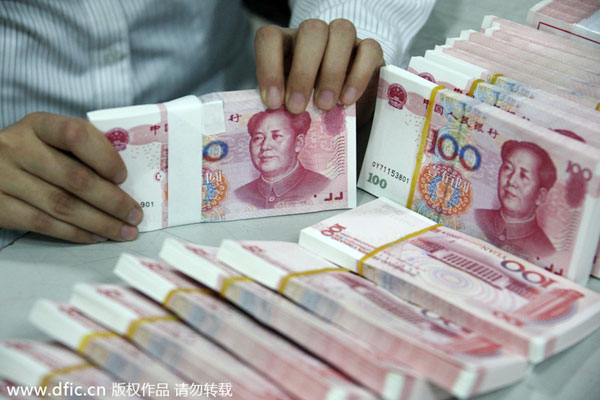
A clerk counts yuan bills at a bank in Huaibei, East China's Anhui province. [Photo/IC] |
BEIJING - The latest quarterly reports of Chinese banks pointed to milder growth in bad loans, adding to evidence that the country's credit risk is under control albeit increasing.
China Construction Bank (CCB), one of China's "big four" state-owned lenders, posted a 1.56-percent non-performing loan (NPL) ratio at the end of September, down from 1.58 percent at the end of 2015.
China Minsheng Bank and China Everbright Bank, two smaller lenders, saw their bad loan ratios drop 0.03 percentage points and 0.1 percentage point, respectively, in the past three quarters.
Agricultural Bank of China, another of the "big four," kept a stable NPL ratio, while that of Industrial and Commercial Bank of China (ICBC), the country's largest lender, rose to 1.62 percent from 1.5 percent at the end of 2015.
Though some banks' NPL ratios continued to increase, overall growth was subdued compared with late 2015, when almost all banks reported higher NPL ratios, said Guo Tianyong, a researcher at the Central University of Finance and Economics.
He attributed the improvement to a stabilizing economy and counter measures introduced by lenders.
Concerns about the quality of China's banking assets have been on the rise amid fast credit expansion, as the country seeks to prop up the economy against a backdrop of lackluster global growth.
Chinese banks as a whole saw an NPL ratio of 1.75 percent at the end of June, stable from a quarter earlier but up from 1.67 percent at the end of 2015, with bad loans reaching 1.44 trillion yuan ($213 billion), according to official data.
In a sign of abating pressure, the country's economy stabilized in recent months, holding steady at 6.7-percent growth in the third quarter of 2016. Its manufacturing sector expanded at the fastest pace in more than two years in October, well above market expectations.
Banks have used their profits and loss provisions to write off bad loans, while adjusting their lending structure to avoid potential losses.
Lenders in?East China's Jiangsu province rejected combined applications of 16.5 billion yuan of loans in five poorly performing industries in the first nine months of this year, said Ding Can, deputy head of the provincial banking watchdog.
In contrast, loans to strategic emerging industries such as new materials, high-end equipment and biotechnology reached 311.7 billion yuan at the end of September, up 41.6 billion yuan since the start of the year, Ding told Xinhua.
Moreover, banks are exploring new ways to tackle bad loans. China has allowed lenders to issue asset-backed securities using NPLs as collateral on a trial basis. Last month, the government detailed a plan for the long-discussed debt-for-equity swaps, where companies can exchange bad debt for stocks.
Overall, China's banking sector has a relatively high provision coverage ratio, capital adequacy and profitability; and the country's credit risk is controllable, said Wang Zhaoxing, deputy chair of China Banking Regulatory Commission (CBRC), the national banking regulator.
It is normal for banks' NPL ratio to go up when the economy slows, he said, noting that the Chinese banking industry's bad loan level is not very high compared with foreign counterparts.
ICBC and CCB saw their provision coverage ratios, a measure of funds set aside to cover loan losses, fall to 136 percent and 149 percent respectively, below the safety threshold of 150 percent set by the CBRC.
However, Guo said a provision coverage ratio of above 100 percent is enough to offset bad loan losses in theory, adding that the risk is under control.
Analysts have called on authorities to stay cautious as uncertainties in the Chinese economy remain.
Zhao Qingming, an economist with China Financial Futures Exchange, predicted that Chinese banks' bad loans will continue to rise but at a slower rate in future as the country cuts industrial capacity and goes through structural transition.
The banks should watch out for an increase in "special mention" loans, loans that are performing currently but could potentially turn sour, said Wen Bin, a researcher at China Minsheng Bank.
The "special-mention" loans of Shanghai Pudong Development Bank, a medium-sized lender, surged 68 percent in the past three quarters to 109 billion yuan, while that of Industrial Bank rose 43.7 percent to 60 billion yuan, according to the banks' quarterly reports.