Home /
Business
/ Industries
Home /
Business
/ Industries
Office realty joins sharing economy


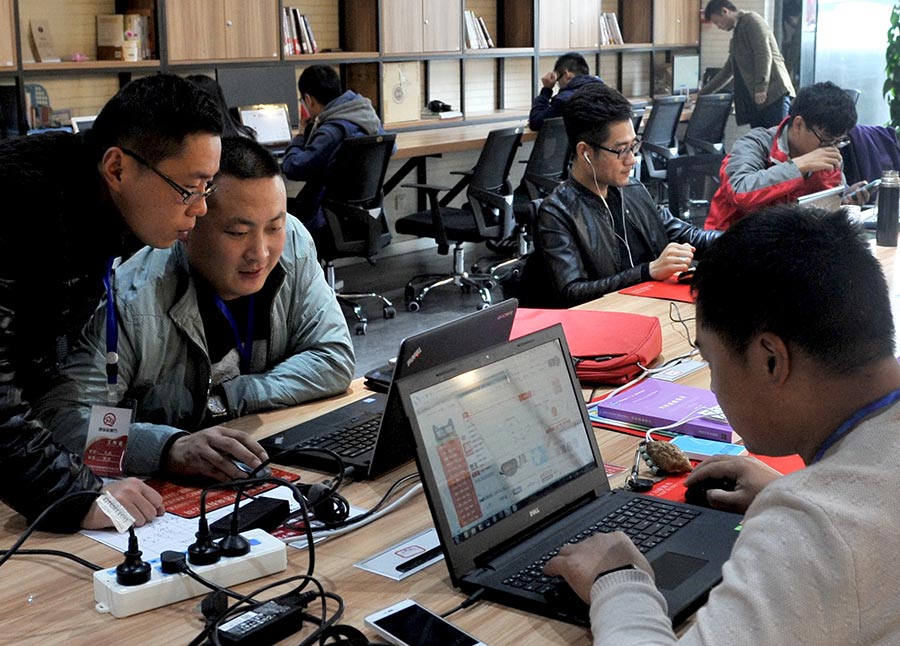
People work at a co-work space in Liaocheng,Shandong province,Oct 28, 2016. [Photo/China Daily]
Popularity of the co-work space business spreads like wildfire among entrepreneurs, stoking a new culture
These days, "Shanghai 189 Lane", Citic Capital's colorfully decorated and brightly illumined seven-story shopping complex in downtown Shanghai, sees an endless stream of young people entering and exiting, morning till late night. The year-end winter chill is no bar for them-but Christmas shopping isn't what they are here for.
They are the city's entrepreneurs and self-employed professionals, out to view the floor plans of the top two stories of the complex.
That's where lots of co-work spaces have been installed of late. Shanghai 189 Lane is one of the 200-odd co-work space sites that have mushroomed across the city.
Zhang Yueqiang, a startup co-founder who is expecting to launch a visual reality content design outfit soon, said: "I've visited 18 sites in Shanghai in the last one week, and I'm thinking of moving into one of them at the beginning of 2017. Some are offering discounted rates at the year-end. But my co-founder said we should visit some more as there are plenty of choices now.
"We need to choose the most cost-effective one, taking rental, location and services into consideration."
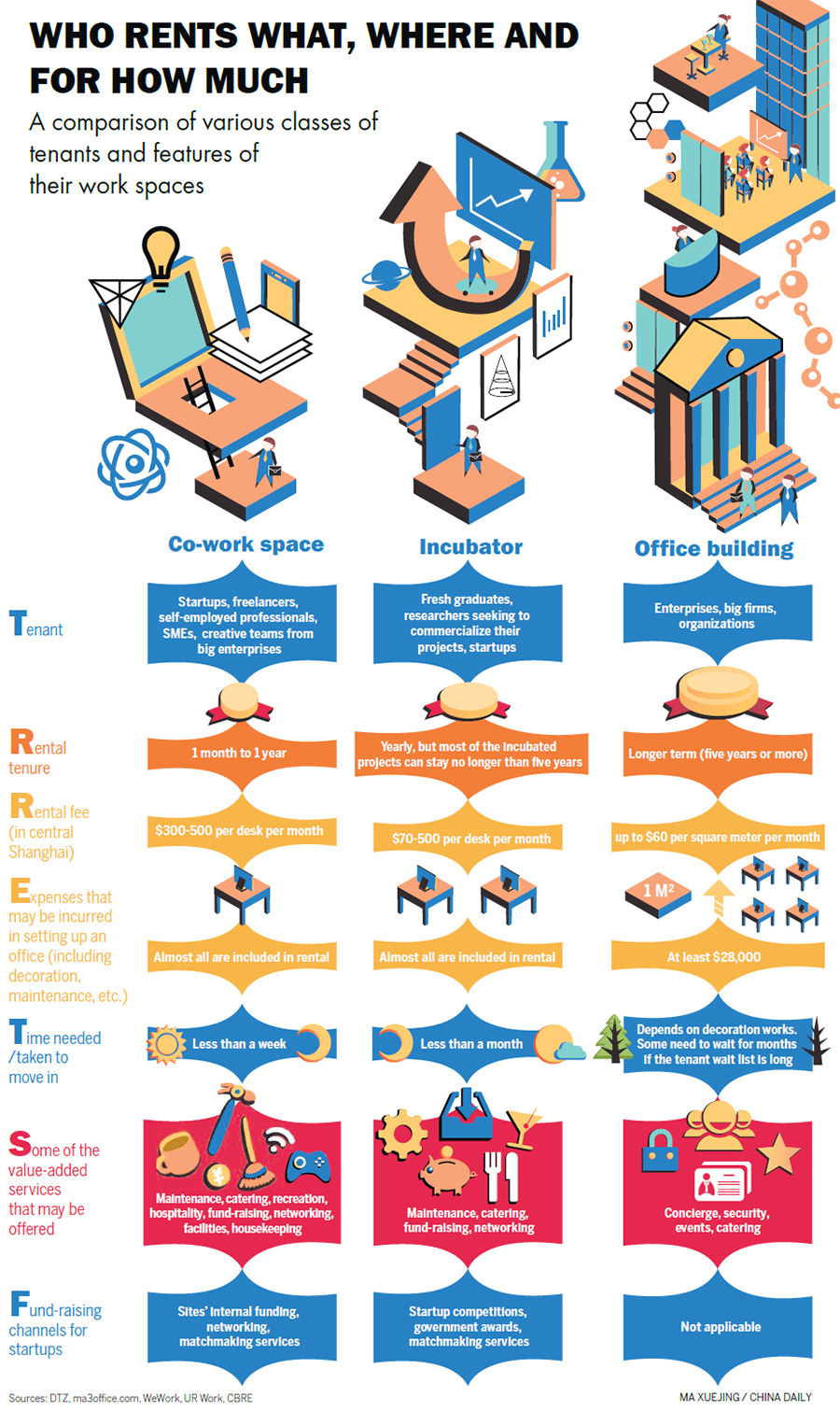
Convenient, flexible, and affordable, co-work spaces have become the first choice of many startups, freelancers, independent players and self-employed professionals on the lookout for offices in Beijing and Shanghai.
According to a research note by JLL, a real estate services provider, the number of co-work spaces in Beijing and Shanghai has jumped to over 500 from no more than 10 just five years ago.
A research note from Shanghai-based Ruiyi Consultancy Ltd said the co-work space market by floor space grew 71 precent annually on average from 2007 to 2015, and is projected to grow 68 percent annually from 2016 to 2018.
Companies from different fields such as real estate (UR Work, Soho 3Q), hospitality (Naked Hub which owns several resorts and hotel sites), and media (KrSpace) have entered the co-work space market and expanded quickly.
That's not all. Foreign brands in this segment like WeWork from the US are trying to meet China's rising demand for co-work spaces.
WeWork received $430 million in funding from China's Legend Holdings. The latter's private equity arm Hony Capital valued WeWork at more than $15 billion.
WeWork has opened two co-work sites in Shanghai. It is preparing to launch a third one now, and is also expanding to Beijing.
Mao Daqing, founder of UR Work, said his co-work space brand aims to increase the number of its sites from 40 across 10 cities by this year-end to 60 in 2017.
Naked Hub announced in late November that it will accelerate its regional expansion and enhance its property resources via Gaw Capital Partners, aiming to add up to 30 new locations, or about 150,000 square meters and 30,000 members across the Chinese mainland, Hong Kong, and other key cities in Asia.
A research note from CBRE on innovative sectors' leasing trends said that China's small enterprises and startups are favoring co-work spaces because their cost is "lower" and their atmosphere appeals to young talent, particularly those working in the TMT (technology, media and telecommunication) space.
Sam Xie, research director of CBRE China, said innovative talent tends to work at sites in convenient locations. And when they work together, they can form a "cluster".
"Co-work spaces are meeting these demands, so they are increasingly favored," said Xie.
Tenants have other considerations too, said real estate agents.
Feng Yunxi, a real estate agent with Shanghai-based Fengxiang Real Estate Co, said: "Innovation and entrepreneurship have become a national aspiration. An increasing number of startups are emerging. All of them need a decent space to operate from. They can actually work from their homes or even rented residential flats to save on costs.
"But they are looking for a community, where they can feel that they are not alone, where they can get resources, such as business opportunities from other tenants, on short-term lease basis. That's so because startups do realize there's no certainty they will survive in the long run and thrive. If they do, they may need to move to a larger office."
That would be a risk though, from the space provider's perspective. Whether tenants' businesses succeed or fail, they would eventually likely move out, leaving the office desks empty. So, operators are evolving new strategies to make their own business viable in the long run.
In addition to startups and freelancers, mid-sized and large enterprises are also being courted by co-work site operators.
"Co-work spaces may no longer be an exclusive zone for small businesses. Operators' huge investments need a stable turnover. So, a balanced tenant portfolio becomes necessary to hedge risks.
"In the US where co-work spaces first emerged, and in Hong Kong where co-work spaces are common, bigger businesses such as banks and technology companies have moved some of their teams to co-work spaces.
"The younger generation among their staff prefer such atmosphere and some creative arms of established businesses may not find a fixed seat comfortable and suitable. I think in the Chinese mainland, more co-work spaces will allocate more resources to bigger tenants in the future," said Kenneth Rhee, CEO of Huhan Business Advisory (Shanghai).